
Cloud-based information technology service management (ITSM) platforms like ServiceNow help businesses automate IT processes, simplify workflows, and reduce operational costs.
One hiccup with ServiceNow, particularly, is how hush-hush their pricing information is. It often leads to confusing bills before and after commitment. This is similar to dining at some restaurants—while the initial cost may seem straightforward, fees such as VAT, service charges, and tips often add up.
Similarly, the real cost of implementing ServiceNow goes beyond licensing and includes training, consultants, scope creep, staffing, customizations, and unforeseen challenges. But the benefits are worth it. Based on ScienceSoft’s experience with ITSM automation projects, companies can cut IT service delivery costs by up to 80%, reduce IT staff effort per incident by 66% through intelligent routing, and boost overall productivity by around 20% using self-service portals and virtual agents.
An example is how The British Telecom (BT) Group consolidated 56 legacy systems using ServiceNow, with a projected savings of £25 million by 2027.
So, what’s the implementation cost to get you started?
This blog post breaks down ServiceNow implementation costs, from aligning business goals to post-launch support, helping you avoid surprises and maximize value.
What is ServiceNow?
ServiceNow is a cloud-based system designed to automate workflows and manage processes. It goes beyond managing and automating IT processes and services like ticketing, service delivery (ITSM), asset management (ITAM), and application portfolio management.
Its comprehensive suite of features include:
Core Platform Capabilities
- Workflow Automation: Automates workflows with visual designers, flow triggers, and approval systems.
- Workflow Data Fabric: Connects and organizes data across diverse systems, enabling businesses to act on insights and streamline processes more effectively.
- Low-Code/No-Code Development (Now Platform): Simplifies app creation using tools like App Engine Studio and Integration Hub.
- Integration Hub: Connects ServiceNow to external systems with pre-built spokes and custom integrations.
- AI Agents: Automates repetitive tasks, content creation, classification, and summarization with custom AI agents.
- Performance Analytics and Reporting: Provides real-time visibility into metrics via dashboards and customizable reports.
- Mobile App Access: Enables users to interact with the platform through iOS and Android native apps.
Human Resources Service Delivery (HRSD)
- Employee Center: Provides a unified portal to access HR services and information.
- HR Case Management: Manages employee inquiries and requests.
ITSM
- Predictive Intelligence: Uses machine learning to predict incident categories, prioritize issues, and suggest resolutions.
- Virtual Agent: Uses AI to enable self-service and automate support.
- ITOM Visibility: Provides a comprehensive view of IT infrastructure and services.
- ITOM Optimization: Optimizes cloud resources and costs.
ITOM
- AIOps: Applies AI to IT operations to automate event management, detect anomalies, and predict outages.
- Service Mapping: Automatically discovers and maps the relationships between IT services and underlying infrastructure.
IT Asset Management (ITAM)
- Hardware Asset Management: Manages hardware lifecycles, from procurement to disposal.
- Software Asset Management: Optimizes software licensing and compliance.
Security Operations (SecOps)
- Security Incident Response: Automates security incident triage, investigation, and remediation.
- Vulnerability Response: Prioritizes and remediates vulnerabilities based on risk.
- Threat Intelligence: Integrates with threat intelligence feeds to identify and respond to threats.
Customer Service Management (CSM)
- Customer Service Management Pro: Adds advanced features like case routing, knowledge management, and field service management.
- Predictive Intelligence for CSM: Uses AI to predict customer issues and recommend solutions.
Business Applications
- Project Portfolio Management (PPM): Oversees projects, resources, and budgets.
- Governance, Risk, and Compliance (GRC): Manages risks, compliance, and audits.
Breakdown of ServiceNow Pricing
Truthfully, we can’t know everything about ServiceNow pricing because every client and use case is different. Additional costs may also vary.
Common costs associated with ServiceNow are categorized into three phases: pre-implementation, go-live, and post-implementation costs. Each phase carries its expenses that can significantly impact the overall budget.
Let’s break these down.
Pre-Implementation Costs
Pre-implementation costs are the expenses incurred before deploying ServiceNow. These may include:
- Project Scoping and Requirement Gathering: Involves initial consultations with experts and internal teams to define the project scope and gather business requirements
- Business Process Analysis: Evaluates existing workflows and processes to identify areas for improvement
- Data Migration: Transfers existing data into the new ServiceNow environment. Costs vary based on data volume, complexity, and the tools used
- Consultation and Setup Costs: Covers professional services from ServiceNow or third-party consultants for configuration, customization, and integration
Depending on the complexity of the implementation, these fees can range from $30 to $80 per hour, $400 to $600 per day, or an annual fee between $30,000 and $70,000.
Consultants usually charge on-time consultation fees or full-scale ServiceNow implementation. Full-scale would be part of your go-live costs.
Go-Live Costs
Go-live costs are incurred during the actual implementation of ServiceNow. This phase typically includes:
- Setup and installation fees for configuring the tool across the organization + technical support
- Customization and integration costs to connect ServiceNow with existing IT systems. Add-ons such as advanced AI features or additional modules can add substantially to the total cost; sometimes ranging from 50% to 60% of the original license fee
- Testing fees to ensure smooth operation before full deployment
- Initial and ongoing training costs for users and managers of the new system
Go-live costs range from $10,000 to $100,000.
Post-Implementation Costs
Post-implementation costs involve ongoing expenses after ServiceNow has been deployed. Key components include:
- Subscription Fees: Organizations must pay for ongoing access to ServiceNow’s services, typically charged per user. For example, ITSM licenses may start at around $90/month per user, with advanced modules like ITOM costing between $150 and $200 per user per month.
- Annual Maintenance Fees: Besides subscription fees, there is usually an annual maintenance fee starting from around $200. This fee covers software upgrades and ongoing support services.
- Additional Features: As time passes, organizations may decide to add more users or expand ServiceNow to other departments, leading to increased costs.
ServiceNow Total Cost of Ownership (TCO)
The TCO for ServiceNow includes multiple cost components that organizations must consider. For a detailed phase-by-phase analysis covering module-specific pricing across ITSM, ITOM, HRSD, and CSM, this ServiceNow implementation cost guide breaks down expenses from initial scoping through hypercare support. Below is an improved breakdown of these components:
Consultation and Setup Costs
Organizations incur consultation fees before ServiceNow implementation, which vary based on business complexity and customization needs:
- Small to Medium Businesses: $20,000-$50,000
- Larger Enterprises: $100,000-$500,000
Additional customizations may add $10,000 or more to the ServiceNow price.
Service Costs
ServiceNow operates on a subscription model or perpetual licensing (cost primarily depends on the company), with costs depending on the number of users and selected features.
Here are the prices:
- Base Package: $100/month per user
- Enterprise-Level Solutions: $50 to $75/month per user
Advanced features can cost up to $200 per month.
Integration and Migration Costs
Data migration and third-party integrations can significantly impact costs:
- Migration Costs: These range from a few thousand dollars to over $100,000 for complex migrations. Tools like Precision Bridge cost $4,950 for basic instance connections. Ensure you partner with a experienced service provider when handling a ServiceNow migration.
- Integration Costs: Integration Hub licenses start at $100/month for the Standard Edition.
Many organizations also need to connect ServiceNow with custom-built tools and internal portals. If your business requires a tailored solution, working with a specialized app development team can help build custom applications that integrate seamlessly with your ServiceNow environment.
Training Costs
Training expenses start from $500 for on-demand courses, and instructor-led training goes up to $2,700. Certifications vary from $300 to $15,000 for advanced programs.
Maintenance Costs
Ongoing maintenance is critical for platform functionality and security. Annual maintenance fees start at $200/year but can increase based on the required support levels and implementation complexity.
Key Factors Influencing ServiceNow Pricing
As you’ve seen, ServiceNow’s pricing model is complex. Four key factors significantly influence this complexity. These include:
Company Size and Revenue
The size of an organization plays a crucial role in determining ServiceNow costs. Larger companies typically require more licenses and modules to accommodate their complex operational needs, which can lead to higher overall expenses.
Let’s take a closer look:
- License Requirements: Larger enterprises may need to purchase licenses for hundreds or thousands of users, which can cost up to $100/month per user depending on the specific services required and the number of users.
- Volume Discounts: Bigger organizations often have the leverage to negotiate volume discounts, potentially reducing costs by 40-50% for core modules like ITSM.
Industry and Geographical Region
ServiceNow tailors its pricing based on industry-specific requirements and regional considerations. Different industries, such as healthcare, finance, or manufacturing, may require specialized features that can influence pricing.
For example, security, e-commerce, government, and healthcare organizations might need additional compliance-related functionalities, which can increase costs. There are also regional variations.
Pricing may also vary based on geographical location due to differences in market demand and local regulations. Organizations in regions with higher operational costs may face increased pricing structures.
Business Goals and User Needs
Customization based on organizational goals and user needs is a significant factor in ServiceNow pricing.
ServiceNow offers Out-of-the-Box (OOB) solutions for different automation workflows, such as incident management. These solutions are more affordable and more straightforward for companies to deploy and manage; they only require updating some data for lookup, user information, and CMDB.
Although the OOB solutions are solid, it’s hard not to configure them to meet your specific features, integrations, and configurations. Customization runs up costs because you need specialists and consultants to execute them.
Product and Licensing Model
The choice of product and licensing model directly affects the cost structure”
- Bundled vs. Standalone Packages: Bundled packages may provide cost savings, but they can also require paying for unnecessary functionalities. Conversely, standalone modules allow for more tailored solutions but may result in higher cumulative costs.
- Subscription vs. Perpetual Licensing: You can choose between subscription-based pricing (monthly or annually) or perpetual licensing (one-time fee plus annual maintenance). Subscription models offer more flexibility but can accumulate higher long-term costs if not managed properly. There are also different types of licensing depending on the role.
| License Type | User Role | Cost |
|---|---|---|
| Requester | Submit incident reports and requests | Free |
| Fulfiller | Basic request management | Paid |
| Business Stakeholder | Advanced request management and analytics | Paid |
| Unrestricted | No limitations (counted as the number of active users) | Paid |
Reduce ServiceNow Implementation Costs and Boost ROI with Apty
Let’s assume you’ve spent $$$ implementing ServiceNow, yet nothing has changed. Your workflow and processes are still experiencing the same issues.
It’s going to hit both you and your company’s wallet.
But there’s a solution: Apty. An AI-powered digital adoption platform (DAP) that helps reduce software costs and increase software utilization and adoption return on investment (ROI).
Apty provides contextual, in-app guidance and real-time assistance during ServiceNow user onboarding. It helps reduce the learning curve and improves time to value. It can also identify unnecessary steps in workflows, improving the quality of your automation and understanding of the ServiceNow platform.
See how Apty can transform your ServiceNow experience. Book a demo today to explore its features and benefits firsthand!
FAQs
- How long does a ServiceNow implementation take?
Typically, ServiceNow implementation takes 4-6 weeks for basic configurations to 6-12 months for complex, multi-module enterprise deployments. Organizational size, customization needs, and module complexity significantly influence implementation timelines.
- What is ServiceNow’s time to value?
ServiceNow accelerates business value through pre-configured solutions, AI-powered recommendations, and workflow automation. Organizations can realize initial benefits within 3-6 months, with continuous optimization enabling ongoing efficiency improvements and strategic transformations.
In 2017, J.P. Morgan introduced Chase Connect, an app for small and mid-sized companies, demonstrating its commitment to digital transformation in financial services. While a simple solution, it solved a key problem: 38% of startups fail due to cash flow problems.
This is just one example of the bank’s yearly commitment of $12 billion to technology.
J.P. Morgan’s focus on financial digital transformation is not unique. Research suggests that in 2023, global technology investments in banking and financial services was around $650 billion (roughly the size of Sweden’s GDP) and is growing at 9% a year on average. From banking-as-a-service (BaaS) to blockchain, digital transformation in financial services is hard to ignore.
This rapid investment trend is a sign of accelerating financial services digitalization, where institutions are rethinking every touchpoint to create faster, smarter, and more secure financial ecosystems.
In this blog post, we’ll explore what financial digital transformation involves, challenges it faces, and the benefits technology brings to finance.
What is Digital Transformation in Financial Services?
Digital transformation in financial services refers to the use of advanced technologies such as artificial intelligence (AI), cloud computing and data analytics, to find innovative solutions to market changes and customer demands.
For leaders, this means rethinking existing processes, breaking down data silos and focusing on more agile services.
Today, technology can improve operational efficiency, enhance customer experiences, and realize cost effectiveness. For instance, migrating to cloud infrastructure can save traditional banks up to 40% of costs through software and hardware savings, labor cost reduction, and even licensing spends.
In the long run, digitalization supports more personalized, responsive services, leading to stronger customer loyalty and higher lifetime value.
The Challenges to Financial Digital Transformation
Digital transformation in finance is reshaping the industry at an unprecedented rate, but it comes with unique challenges. From resistance to new technology to cybersecurity threats, roadblocks to financial digital transformation are plenty.
Yet, as we’ll see in a subsequent section, the benefits far outweigh the challenges. Before going into its advantages, let’s look at the challenges.
Digital upskilling and onboarding
Adopting financial technology requires employees to master new tools, which can create skill gaps and lead to resistance to change, making additional training necessary. Successful implementation of technology requires both technical training and cultural shifts within organizations.
In banks and financial institutions, this challenge is further compounded because of its high-stakes environment, where mistakes during the learning curve can lead to regulatory or financial risks.
Using a digital adoption platform (DAP) like Apty can help financial service companies provide employees with contextual as well as personalized AI-driven guidance, and customize their upskilling and onboarding processes to aid learning and cut costs.
Data privacy and cybersecurity
Digital transformation in financial services also comes with the threat of data breaches and cybersecurity attacks that threaten the privacy of sensitive information.
Recently, London-based Finastra that handles banking and wire transfers for more than 8,100 financial institutions globally, reported a major data breach impacting its internal file transfer system. This challenge can be prevented with robust encryption and security protocols, regular security audits, and AI-powered threat detection systems, among other solutions. Implementing ai penetration testing can proactively identify system vulnerabilities before attackers exploit them, strengthening overall cybersecurity resilience and protecting critical financial data.
Integration with legacy software
Combining new digital tools with outdated systems can result in compatibility issues, ineffectiveness and high costs. A PYMNTS report found that 75% of banks struggle with digitalization because of legacy infrastructure. In fact, many banks in the Asia-Pacific continue to rely on decades-old legacy systems.
Instead of rapid digitalization, adopting a phased migration process that still retains critical infrastructure minimizes disruption, as has been seen in leading banks in countries like Australia and Singapore.
Real-time end user support
Complex digital systems can struggle to deliver fast solutions due to delays in troubleshooting, poor integration of customer data, or limited access to technical resources during crises.
For instance, a payment gateway crashing during a trading surge prevents users from executing trades. This results in huge financial losses for users and a damaged reputation for the financial intermediary.
Understanding end-user pain points
Failure to fully comprehend end-user needs can be frustrating for customers because of poorly designed or irrelevant digital solutions.
For example, providing customers with advanced cryptocurrency trades while having a user interface (UI) that is non-intuitive can result in low adoption rates. Companies like PayPal have overcome this through user journey mapping and A/B testing.
Cost of new technology
Advanced technologies such as AI or blockchain may require large upfront investments, ongoing maintenance costs and specialized expertise. These barriers can be prohibitive for smaller firms unless they explore cost-sharing models.
Regulatory compliance
As mentioned before, digital transformation in financial services requires compliance with many regulatory needs. For example, European Union (EU) banks and financial institutions that use AI must align with the GDPR, which has strict rules for data usage, storage and transparency.
Failure to comply with such guidelines can lead to hefty fines and legal repercussions, which can serve as a deterrent for many firms.
Benefits of Financial Services Digital Transformation
Despite its challenges, banks and financial institutions are moving towards digitalization. Players in the industry are recognizing the growing benefits of digital transformation for financial services, such as:
Enhanced customer experience
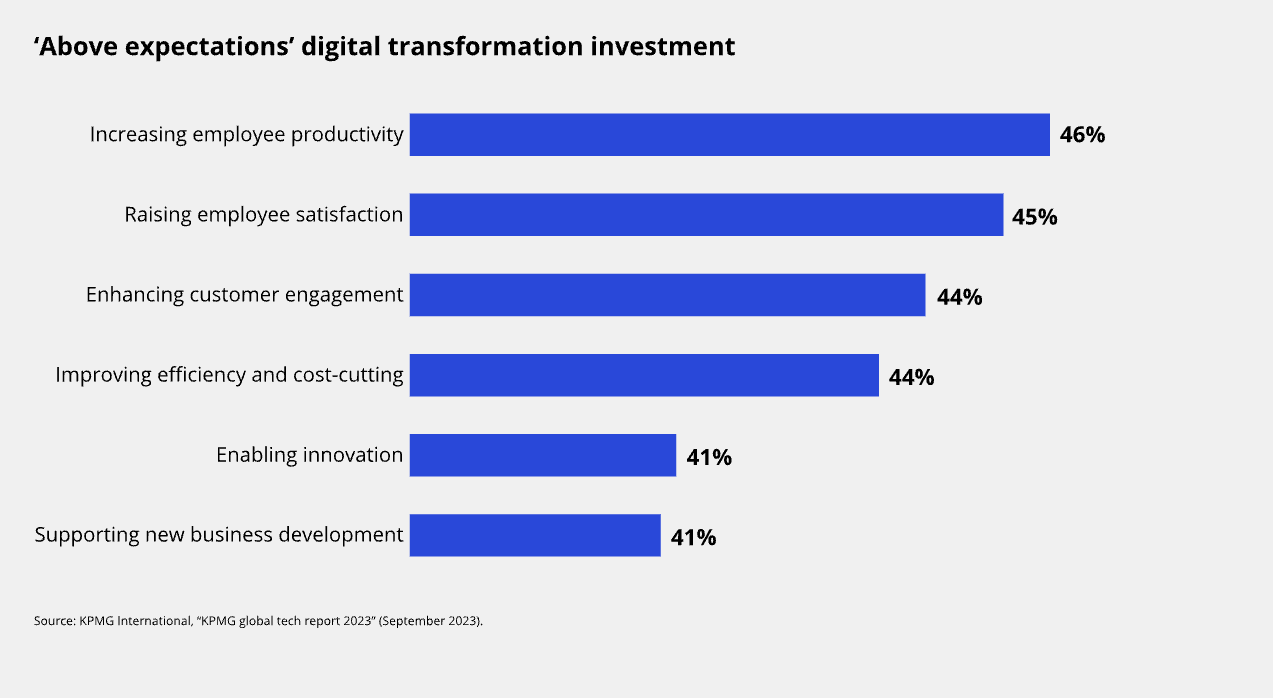
Digital transformation empowers financial institutions to deliver personalized, efficient, and consistent customer interactions. 44% of financial services executives reported enhanced customer engagement due to digital transformation investments.
For instance, implementing AI-powered chatbots and predictive analytics helps banks provide real-time customer support and tailored financial advice. This evolution is particularly visible in the insurtech sector, where AI insurance support has shifted from basic FAQ bots to sophisticated systems capable of managing entire policy lifecycles. Insurance company Lemonade’s AI bots Maya and Jim have made waves for their exceptional customer service and the company now has over 2 million customers.
Moreover, technology-driven personalization is also transforming how financial institutions generate and manage merchant service leads allowing banks and payment providers to identify high-quality prospects through advanced analytics, automate outreach, and improve conversion rates with data-backed insights.
Reduced operational costs
For financial institutions, automation and advanced digital software can streamline manual processes, ultimately cutting costs and enhancing efficiency. A KPMG report suggests that digital investments have already improved efficiency and supported cost benefits by 44% for financial services companies that have implemented them.
One of the major benefits of digital transformation in finance is smarter client management. For example, CRMs enhanced with AI can transform the work of financial advisors. Tools like Apty ensure these platforms are appropriately adopted, minimizing drop-offs and unlocking valuable insights across customer portfolios.
Easy data accessibility and management
Digital transformation for financial services can help collect, analyze, and store data, supporting decision-making with improved customer insights. Centralized platforms can integrate customer relationship management (CRM), transaction history, and third-party data, empowering internal teams with critical insights that can drive faster actions. Moreover, centralized data platforms can also support regulatory compliance through streamlined audits and data alignment with necessary standards.
Process agility and operational productivity
Software and new technology eliminate bottlenecks and combat human errors, which can improve process and operational agility. Machine learning solutions can streamline approvals, for instance, reducing processing time drastically.
The McKinsey Global Institute (MGI) estimates that across the global banking sector, gen AI could add between $200 billion and $340 billion in value annually, or 2.8% to 4.7% of total industry revenues, largely through increased productivity.
Examples of digital transformation in the finance industry
Financial digital transformation isn’t a new phenomenon, with many global companies leading the way. The benefits of digitization are best illustrated with real-life impact. Let’s explore real-world examples of digital transformation in the finance industry.
Digital customer onboarding
HSBC introduced SmartServe for digital onboarding by leveraging AI, machine learning and biometric verification. The impact of SmartServe has enhanced customer experiences where new accounts can be opened, information verified and KYC completed remotely and in real-time, within a few minutes.
At the same time, SmartServe has helped the bank expand into new markets and offer services to customers who may have previously found traditional banking procedures cumbersome.
Latest reports show that SmartServe is live in 19 countries, has more than 1,400 internal users and has onboarded 89% of eligible customers digitally, with 72% of them rating the experience as ‘easy’.
AI-driven fraud detection
Mastercard is paving the way for generative AI fraud detection to protect customers and payment networks. Its decision intelligence (DI) solution, launched earlier this year, scans one trillion data points in real time to detect the genuineness of transactions.
The existing AI technology already helps approve 143 billion transactions a year safely, while the new gen AI can boost fraud detection rates by up to 300%, based on initial modelling.
Robotic process automation
Robotic process automation (RPA) automates repetitive tasks, reducing errors and boosting employee productivity.
Deutsche Bank’s RPA commercialization program in China includes features like automated transaction data extraction and conversion from e-banking platforms, integration across multiple channels such as e-statements and e-wallets, and a zero human intervention reconciliation process. This has reduced reconciliation time from 2-3 days to under an hour. The pilot program shows that it can save the bank 60-80 hours of manpower per month.
CRMs for financial advisors
In 2023, Morgan Stanley took the leap into improving its CRM with an internal AI assistant powered by OpenAI’s ChatGPT technology.
AI @ Morgan Stanley Assistant changed how financial advisors and wealth managers handled client needs. It simplifies mundane tasks by quickly providing answers on investment or business performance from over 100,000 documents—much faster than human intervention. The assistant is seen as a “co-pilot” in the firm’s financial advisory department, with document access increasing from 20% to 80% and over 98% of advisor teams using it actively.
Banking-as-a-Service
The Apple Card, launched in partnership with Goldman Sachs, is a prime example of BaaS. It provides a digital-first banking experience seamlessly integrated within the Apple ecosystem.
While the card itself functions like a typical credit card, its backend infrastructure and financial services are powered by Goldman Sachs, using Apple’s advanced tech ecosystem to deliver a user-friendly, digital experience. Features include real-time transaction tracking, insights into spending habits and cash-back rewards.
Wealth management and Registered Investment Advisor platforms
Aladdin (Asset, Liability, Debt and Derivatives Investment Network) by BlackRock is a tech-powered investment management platform popular among financial institutions, asset managers, and institutional investors. It provides an impressive suite of tools for portfolio construction, risk management, trade execution, and performance analytics.
The system is preferred for its sophisticated risk analytics and ability to aggregate data from multiple sources into a unified view of portfolio performance. A key feature of Aladdin is its support for regulatory compliance, offering tools to help firms stay up-to-date with global regulatory changes.
Chatbots and virtual financial advisors
Going back to Lemonade’s example, the new-age insurer’s AI-driven chatbots, Maya and Jim, have significantly contributed to improved customer satisfaction and business performance.
Maya, the virtual assistant, processes insurance purchases and provides customers with instant quotes and responses. The company handles about 30% of customer interactions with absolutely no human intervention. Lemonade’s Jim handles claims processing and recently set a new record by settling a claim in two seconds.
The Apty Impact on Financial Digital Transformation
Modern software solutions are at the heart of digital transformation across industries. From workflow automations to data-driven analytics, digital tools set the stage for success. Enter Apty.ai .
But adoption is only the starting point. Apty’s AI-powered platform transforms the way banking and financial teams use enterprise software, reducing process errors by 30%, boosting onboarding speeds by 50%, and improving compliance with role-based workflows. The outcome isn’t just adoption, it’s measurable business execution.
With contextual guidance and on-demand training, GenAI capabilities, integrations, and unified workspaces, Apty can accelerate your digital transformation in the finance industry. Apty’s DAP minimizes employee resistance and helps overcome change management challenges with a host of solutions that ensure successful adoption, including:
- in-app guidance to provide users with contextual support without interrupting their workflow
- AI in financial services to help teams adopt and maximize tools like fraud detection engines, AI chatbots, and predictive analytics platforms
- AI-driven features offer role-based guidance, helping employees quickly master new tools and improve software utilization
- step-by-step guidance and process standardization to minimize errors and ensure that employees adhere to company procedures and compliance regulations
- analytics to track software usage patterns, providing organizations with data to optimize software utilization, manage licenses, and improve cost efficiency
Take the case study of this global bank in North America. It sought to improve the training and onboarding of its new project and portfolio management (PPM) software after a year of inefficiency and low productivity. The bank partnered with Apty for a solution.
Apty’s detailed guidance enabled employees to independently follow business processes, while real-time data validations and a predefined format for data entry improved accuracy and eliminated errors. The DAP’s analytics and reporting capabilities provided leadership with better visibility for key decision-making. As a result, the bank saved $1 million (80% of support costs) and reduced adoption time by 30 days.
Want to achieve these results for your own business? Twelve million users and top financial institutions are already using Apty to drive ROI, not just adoption. From AI-powered onboarding to enterprise-wide process standardization, Apty helps reduce errors by 30%, cuts support costs by 80%, and improves adoption time by up to 30 days. Book a demo today!
It’s Friday, and the extensive CRM training is over.
You’re optimistic: no more fragmented data, siloed workflows, or data entry errors. Adoption should be seamless, right? But as weeks pass, the reality sinks in: support tickets are piling up, employee productivity is sinking, and resistance to change is growing.
Why does this happen? Traditional user onboarding, often limited to initial training sessions, misses the mark when driving long-term adoption. Employees need more than just a one-time introduction; they need ongoing guidance and support embedded into their workflows to enable them to follow processes and complete tasks correctly.
With advanced employee training software and AI-driven guidance, enterprises can now support every user in real time. Tools like Apty’s Digital Adoption Platform ensure process compliance and help users complete tasks confidently within any CRM environment.
As this article outlines, the answer lies in strategically merging traditional onboarding practices like training sessions with a technology-driven approach using digital adoption platforms (DAPs).
Let’s start with seven key elements of successful user onboarding.
Note: In the context of this blog post, users refer to employees. Although user onboarding differs from customer and employee onboarding, it is part of employee onboarding.
7 Key Elements of Successful User Onboarding
A successful user onboarding process consists of several components, which can vary depending on brand goals. However, some elements remain consistent across the board. Here are seven of these essential elements:
1. Welcome Screen
The welcome screen greets users and signals the start of their user onboarding flow. It’s like a digital handshake or a friendly hello, setting the tone for the entire user onboarding experience. Here, you encourage users to take their initial steps and get the primary value of the platform.
| Pro tips:Add personalized welcome messages like their names and show features relevant to their roleInclude clear calls to action (CTAs) like “Next,” “Start Setup,” or “Take a Quick Tour”Customize the welcome screen using branded colors and assets. |
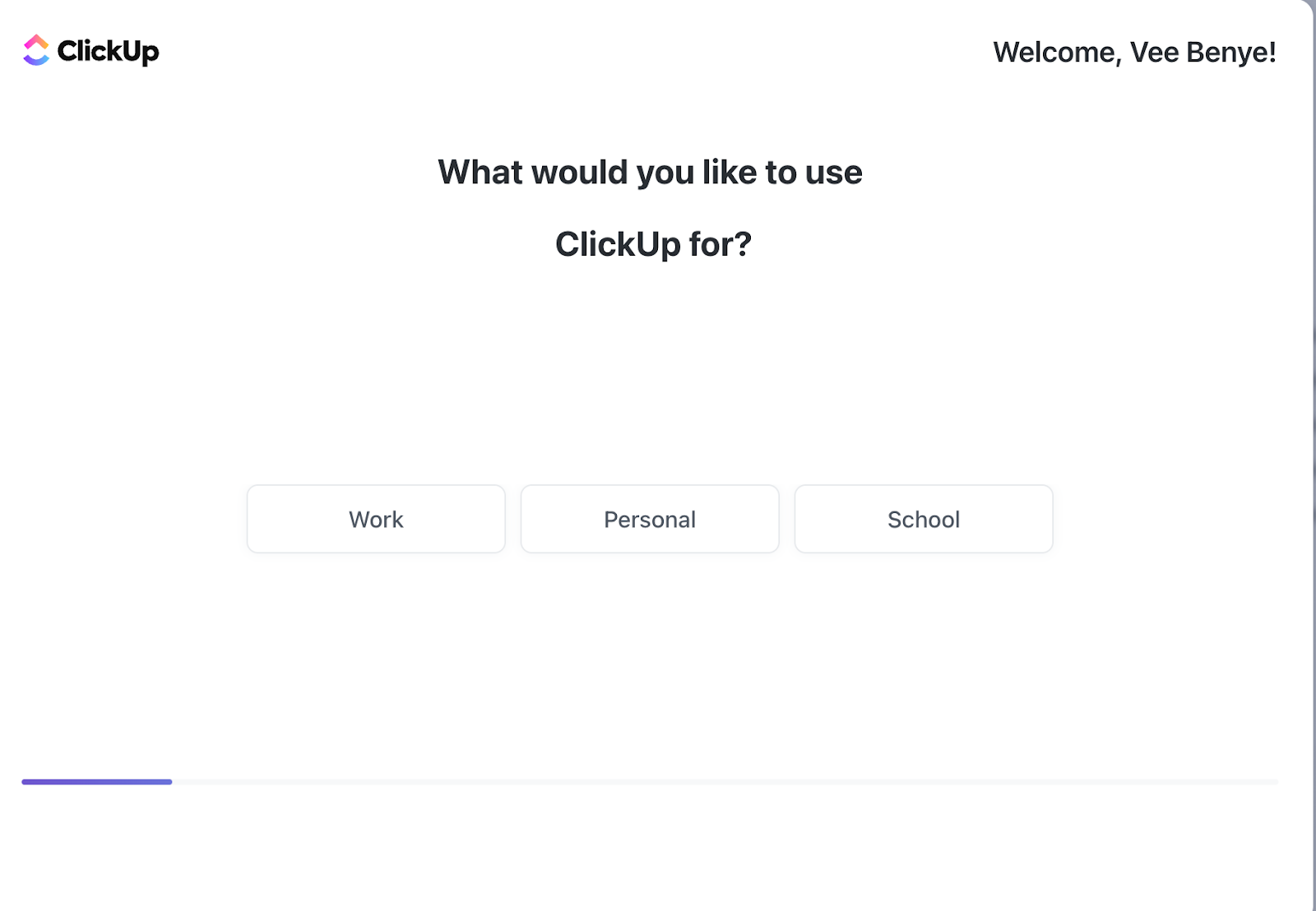
The timing of the welcome screen can vary; it may appear before or after the account setup, depending on your objectives. Some companies, like Notion, show their welcome screen, while ClickUp blends account setup on the welcome page as a call to action (CTA).
2. Account Setup
This element focuses on gathering user information, including their roles, relevant features, team invitations, and integrations.
The goal is to personalize their journey effectively and provide a good user onboarding experience.
| Pro tips:Keep the forms concise. Only ask for essential details and avoid overwhelming usersUse data from integrations to auto-populate fieldsAdd tooltips and contextual cues to guide users Use DAPs like Apty, which allow you to populate data from existing systems to reduce friction automatically |
3. Product Tour
Product tours show employees around the software. They’re done using demo calls, on-demand videos, and DAPs that provide interactive walkthrough experiences around the app. For teams implementing CRM or ERP systems, embedding onboarding software into product tours not only increases adoption but improves employee productivity across workflows.
| Pro tips:Personalize tours based on their roles and tasksCombine interactive walkthroughs with tutorials for more user engagementGive users the option to skip or revisit the tour later. |
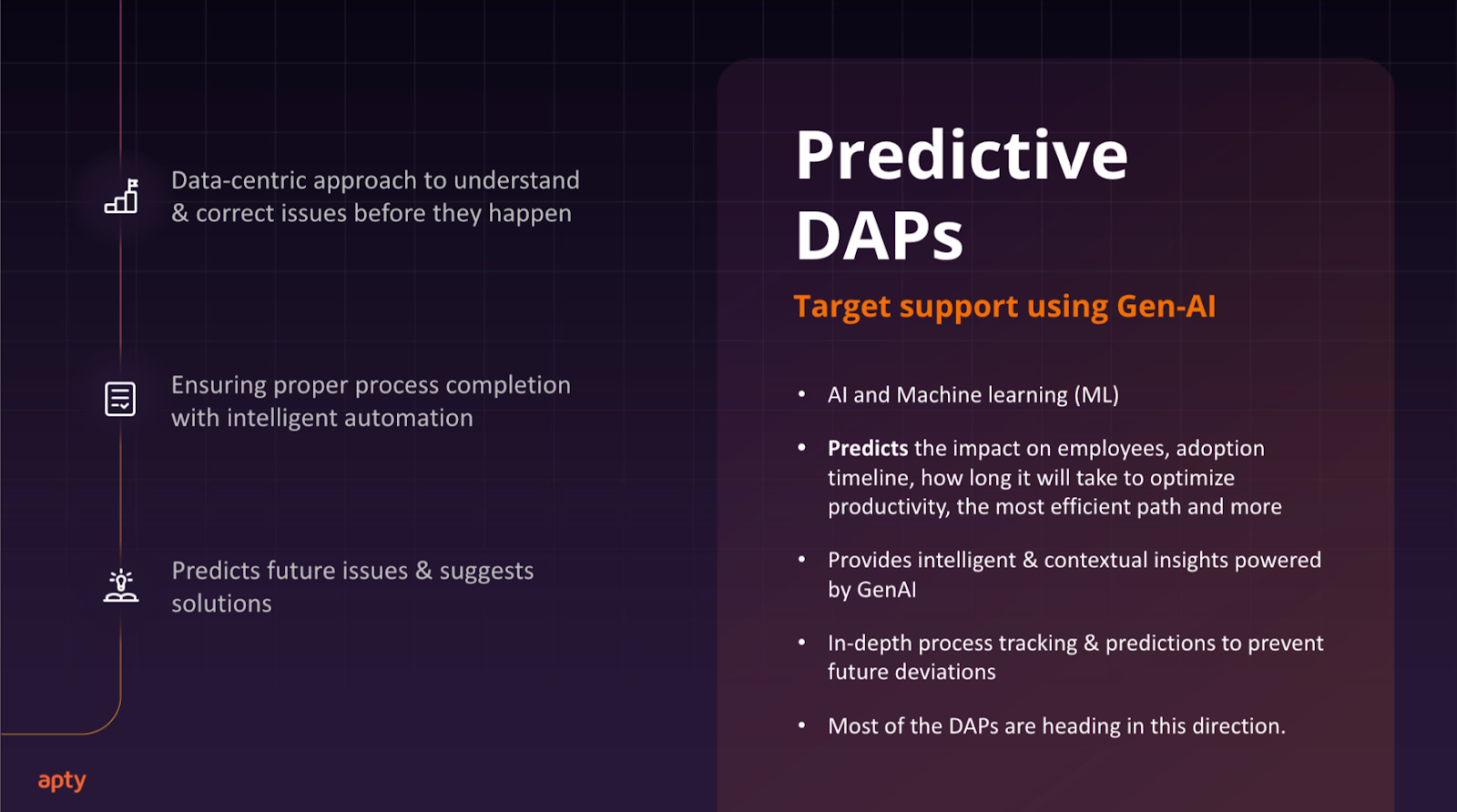
Use proactive and predictive DAPs like Apty to analyze user data using artificial intelligence (AI) and machine learning (ML) during onboarding. Then, it chooses the most efficient path for the product tour and featured showcase.
Reactive DAPs, on the other hand, offer only in-app guidance, tooltips, and basic analytics. Proactive and predictive DAPs take it up a notch.
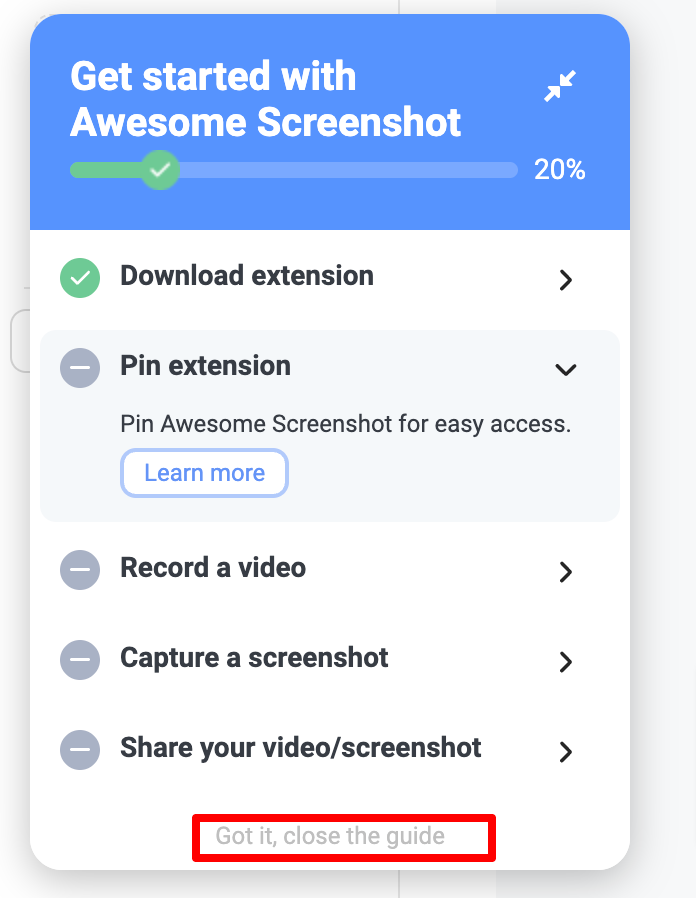
4. Progress Indicators
Progress indicators help users feel accompanied and reduce fatigue by tapping into psychological cues such as the:
- Zeigarnik Effect: Users remember incomplete tasks more, encouraging them to return
- Endowed Progress Effect: Seeing progress (e.g., 2 out of 10 completed) boosts motivation and satisfaction
| Pro tips:Break down the product tour and tasks into smaller stepsProvide positive reinforcement after each task is completedUse visual cues like checklists and progress bars to enhance visibilityAllow users to skip checklists and guides |
5. User Personalization
Personalization allows users to customize their dashboards, themes, and other settings as per their preferences and roles.
| Pro tips:Offer interactive walkthroughs on how to personalize settingsProvide templates, videos, and resources to inspire customization |
6. Task Completion
Often referred to as the “Aha moment,” this occurs when users recognize your platform’s primary value by completing a relevant task. This occurs when users experience a sense of accomplishment and realize the primary value your platform offers by completing a relevant task.
For instance, in ClickUp, users might complete their first task, set up a project, or organize a to-do list. When they successfully navigate these initial steps, they gain confidence in their ability to use the platform and see its practical benefits.
| Pro tips:Break tasks into smaller steps to simplify workflowsUtilize tooltips to assist during the task completion processEmbed resources and guides tailored to users’ roles |
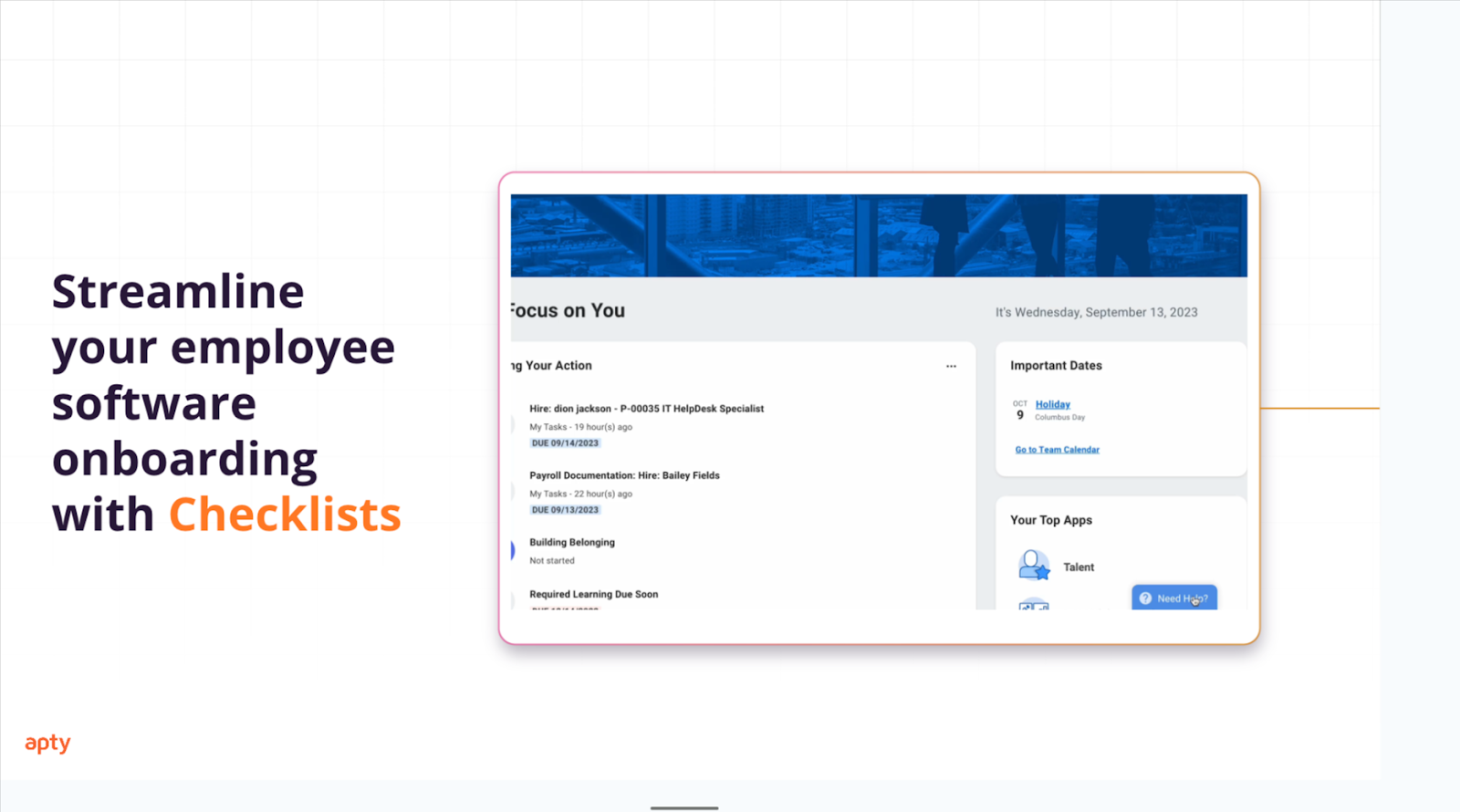
7. Success Messages
Success messages reinforce user progress and momentum, nudging them to continue using the platform and exploring other features. However, success messages don’t always mean onboarding success until the onboarding experience is complete.
A success message can appear after completing a task or account setup.
| Pro tips:Use positive language in success messages.Incorporate fun animations, like confetti, for visual appeal.Add relevant CTAs to encourage further exploration. |
Hurray! You’ve reached the end of this section.
Now, let’s dive into ten proven practices that enhance user adoption! (Your success message? )
10 User Onboarding Best Practices for Enhanced Product Adoption
Now, let’s dive into ten proven practices that enhance user adoption.
-
Research User Needs
Speak to users to understand their learning preferences, knowledge gaps, the features they care about, and the potential impact of the software on their processes. Ask open-ended questions to avoid vague responses.
Here are some open-ended questions you may ask:
- How do you prefer to learn new tools or software through hands-on practice, guided tutorials, or written resources?
- What challenges have you faced when learning new systems in the past?
- What kind of ongoing support would you find helpful after the initial onboarding?
- How do you see this software fitting into your current workflow?
Discuss potential learning disorders or physical limitations, such as color blindness or hearing aids. Quality research minimizes frustrations and drop-offs and increases user retention because the experience is tailored to their needs.
Other ways to conduct quality user research:
- Dig into existing data. Have employees indicated their learning styles and limitations?
- Conduct surveys and interviews to uncover pain points and needs.
- Use behavioral analysis to observe how users currently interact with other enterprise software.
- Create detailed user personas that reflect your users’ roles and needs, tailoring functionalities accordingly. Consider segmenting users into new users, intermediate, and experts to contextualize the training needed.
- Start a pilot test with small group, collect feedback, and gather insights for a wider rollout.
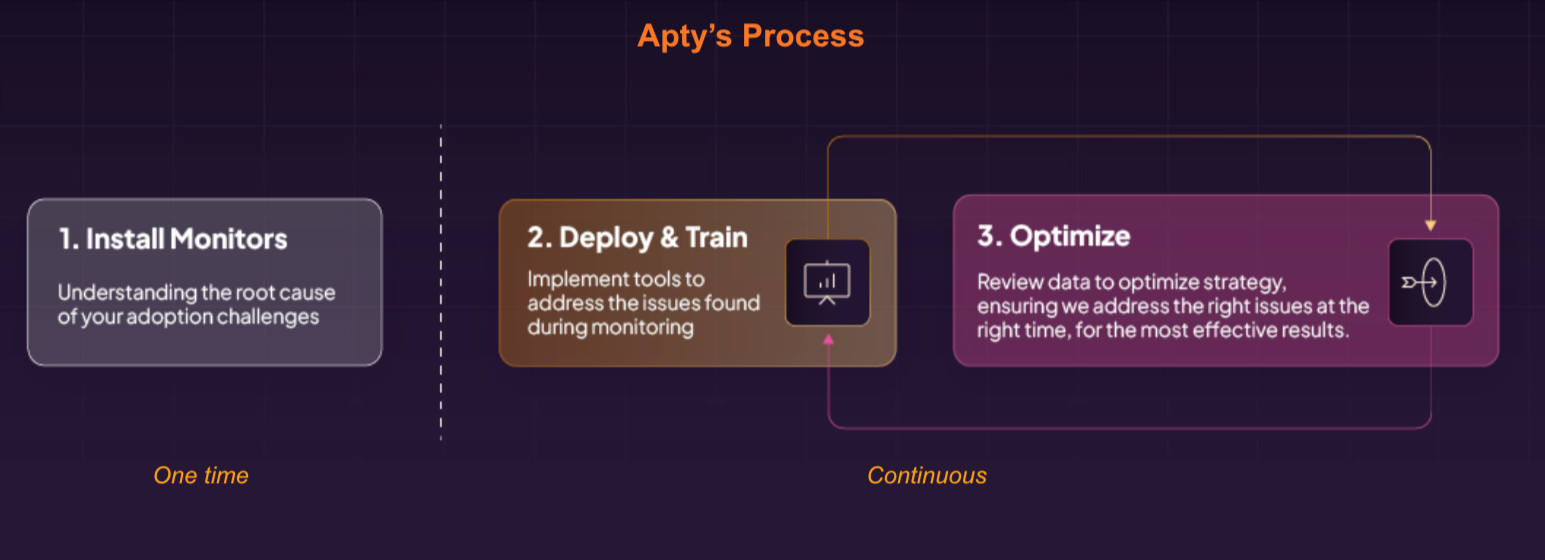
- Use Apty’s AI to analyze your system, gather user-level data, find current bottlenecks, and deliver solutions to enhance software adoption.
-
Reduce Barriers to Entry
After understanding your users’ needs, show them how the software solves their pain points quickly.
Ideal scenario: A project manager logs into a new system, and instead of watching a 20-minute tutorial or lengthy article, they’re welcomed with a personalized, hands-on walkthrough on how to set up tasks and assign work to employees, and complete tasks in a few clicks. Within minutes, they can understand the software’s value to their workflow.
To further streamline the process and improve employee productivity, enterprises can integrate CRM training solutions and user onboarding software that delivers contextual help in real-time. Apty’s AI-powered digital adoption platform plays a pivotal role here, offering guided walkthroughs and analytics to reduce support queries and training costs.
These are some ways to reduce barriers and provide immediate value:
- Simplify initial setup with auto-fill features, pre-loaded templates, and single sign-on (SSO) to reduce time to value.
- Provide immediate feedback, such as “Step 1, complete!” and “Data uploaded successfully.” A checklist or visual progress bar helps users keep track of their progress.
- Focus on quick wins, like taking the user step by step on completing the most basic valuable tasks.
As we’ll see soon, reducing barriers to entry can also be done using contextual and in-app guidance.
Duolingo nails quick onboarding by allowing users to sign up in under a minute, personalize their experience by selecting a language, and immediately begin learning with a short, engaging lesson.

“Two secrets to excellent user onboarding? Tailor it to employee roles and needs. The key is to create a seamless experience that highlights immediate benefits and equips users for long-term success.” – Rongzhong Li, CEO/Founder of Petoi
-
Create Contextual Onboarding Experiences
An HR specialist, customer success manager, and team manager are onboarding on the same platform. The specialist sees steps for setting up employee profiles while the manager receives prompts for tracking performance. On the other hand, customer success managers see ticketing features, cutting unnecessary steps and improving efficiency.
Contextual onboarding experiences mean providing the correct information to the right users at the right time. Instead of overloading the user,it involves providing all relevant information at the start.
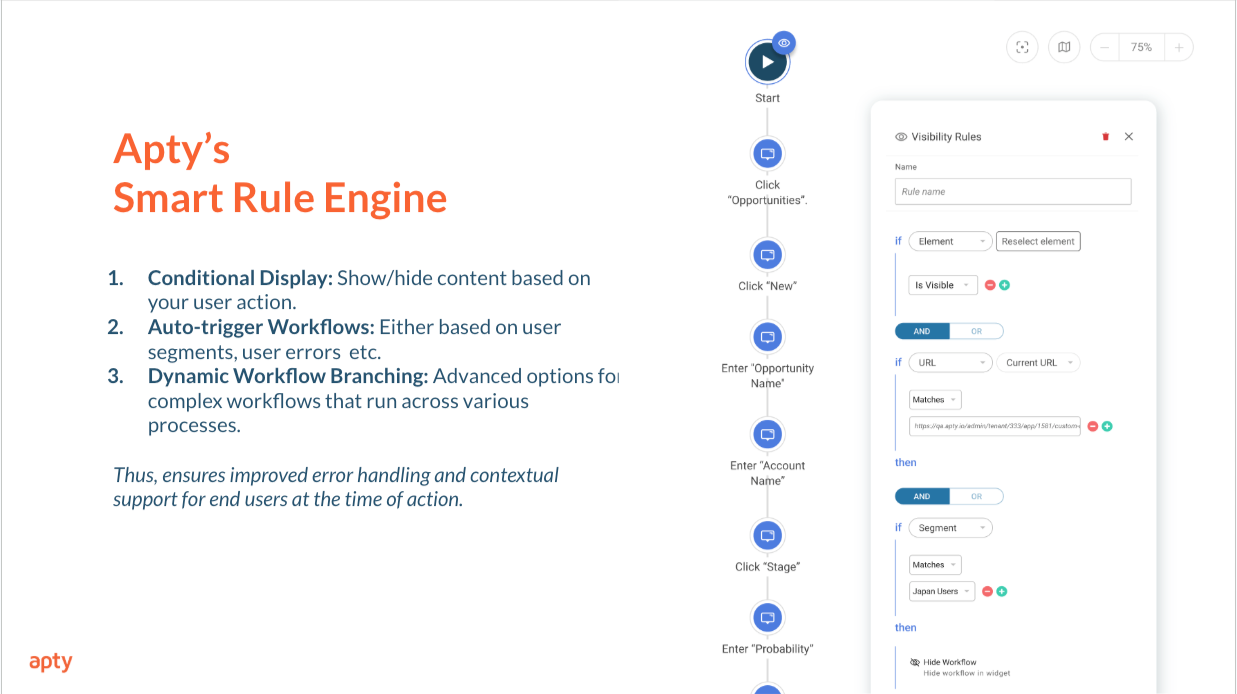
Using a DAP, you can set smart rules to deliver content dynamically, allowing users to see only the correct information based on their actions and choices.
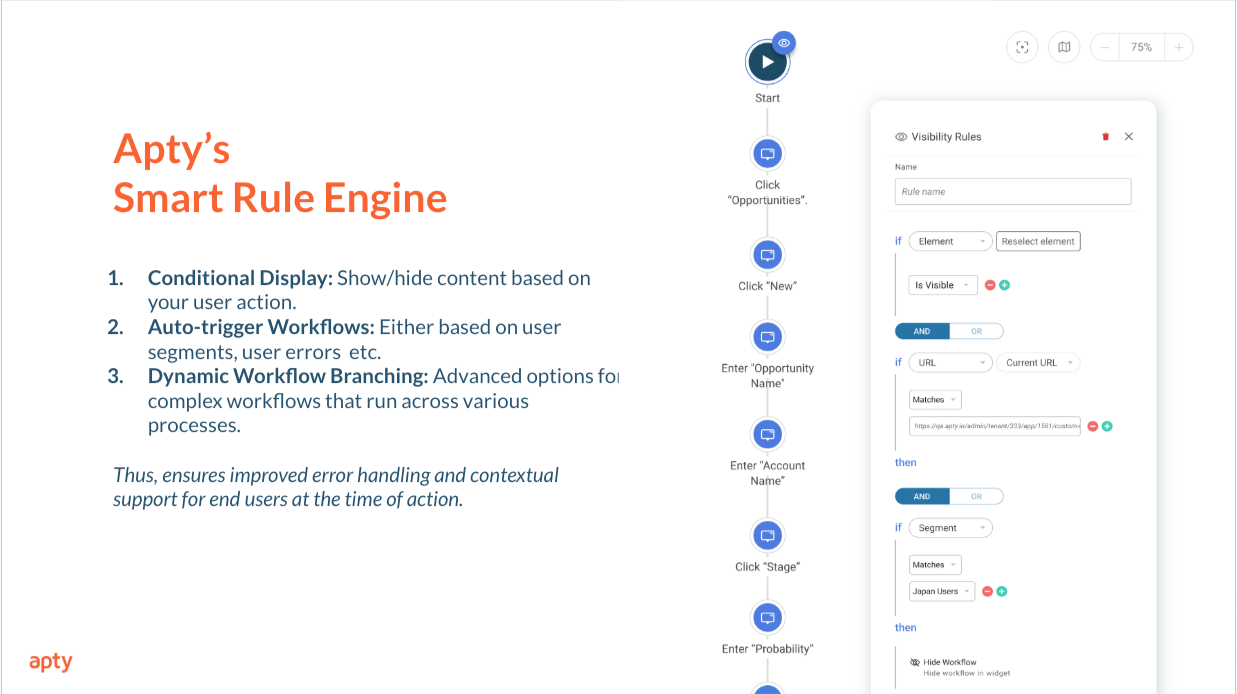
Contextual onboarding uses familiar elements from traditional product tours, such as tooltips, hotspots, modals, progressive disclosure, and checklists. It focuses on timing, delivering tailored guidance based on users’ roles, actions, and behaviors when they need it.
-
Provide In-App Guidance to Help New Users
In-app guidance offers real time, hands-on help tailored to users’ roles and actions. After training, users often forget what they’ve been taught and need guidance as they use the app without needing to leave or contact support.
Incorporating software for change management ensures continuous reinforcement of training and boosts long-term retention, especially when paired with CRM guidance tools like Apty.
You can provide in-app guidance using tooltips, chatbots, popups, interactive walkthroughs, hotspots, and tutorial embeddings in relevant places.
For example, Zoom provides tooltips, chatbots, and media embeddings.
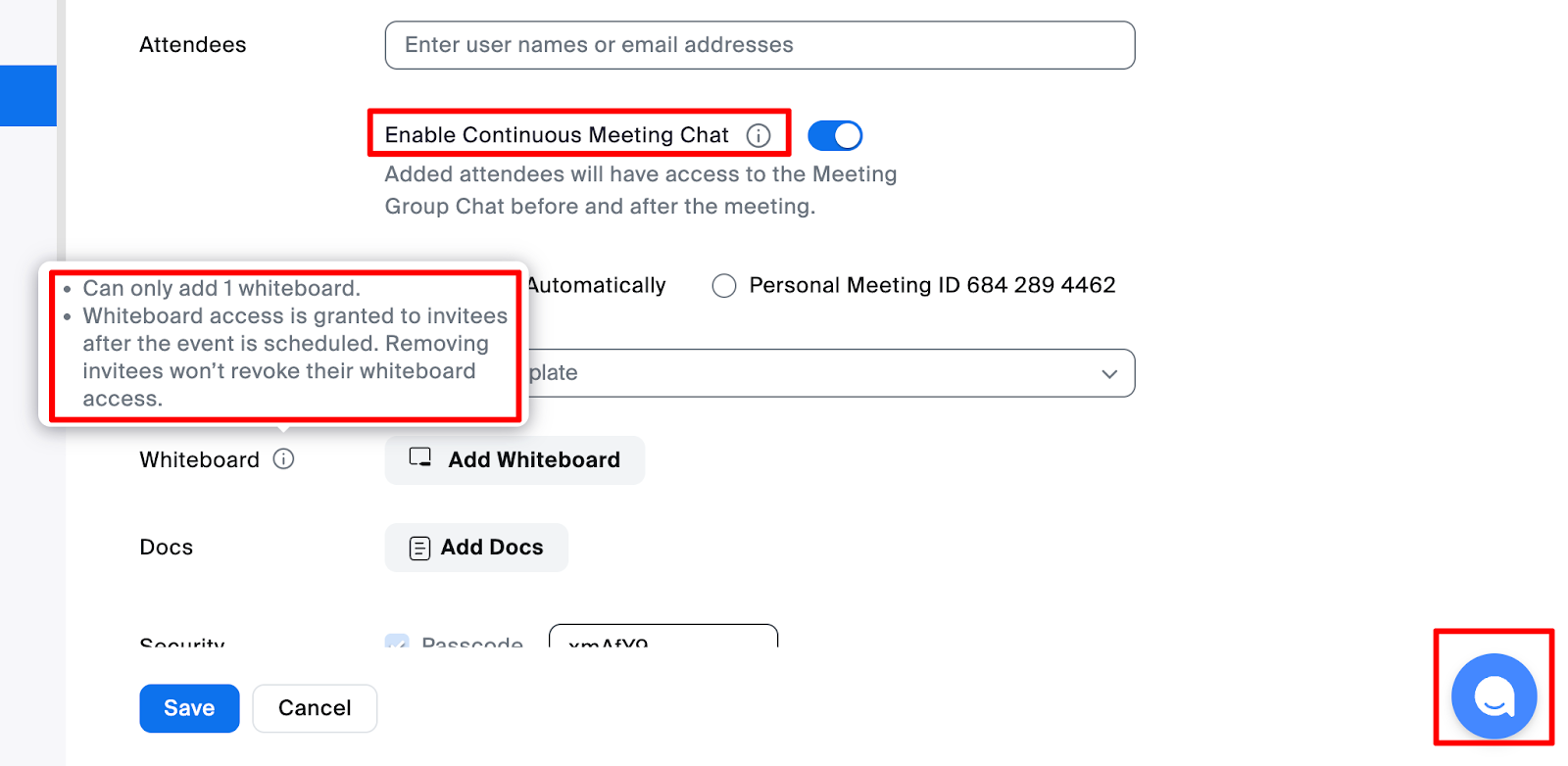
After facing challenges in training their global representatives, Mary Kay turned to Apty for assistance. With Apty’s implementation, the company company provide in-app guidance and targeted training content in 15 languages tailored to various countries.
This led to a significant reduction in support tickets, improved productivity, and enhanced overall performance among their representatives.
Other in-app guides include:
- Continual Triggers: Use action-based triggers to provide relevant tips. For example, when a user generates a report, it shows a message suggesting available templates or a guide on customizing reports.
- Visual Cues: Highlight key elements, such as the “New Project” button, to guide users visually as they learn to perform tasks like creating a project.
-
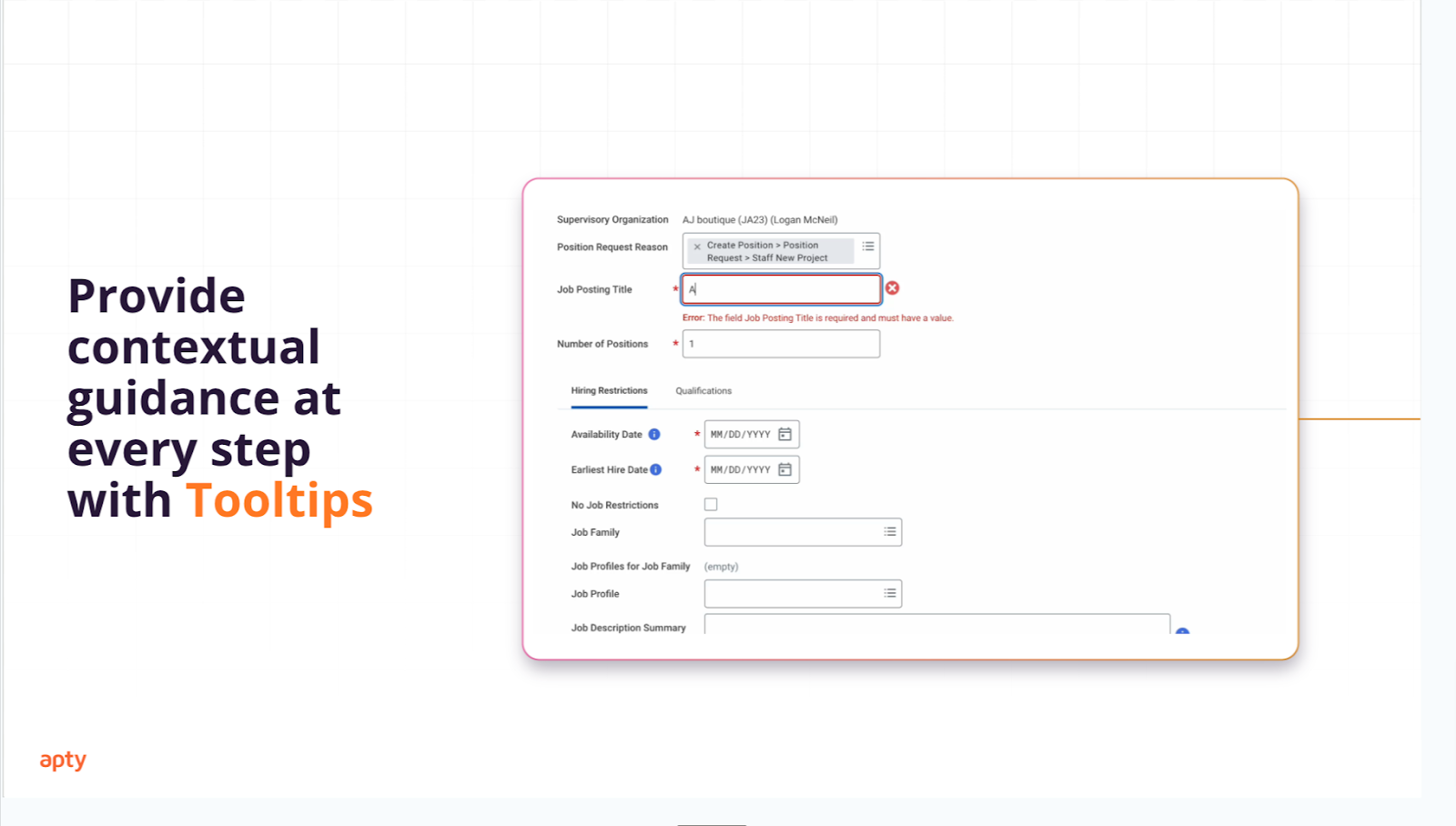
Help Users Discover Relevant Features With Contextual Tooltips
Show the employees relevant features and provide in-the-moment guidance instead of constantly undergoing intensive training. Not every feature needs upfront learning.
Here’s how to use contextual tooltips effectively:
- Strategic Placement: Position tooltips near the right features that may need clarification, like in the Zoom example.
- Role-Specific Prompts: Tailor tips based on user roles for relevance.
For example, the HR department sees prompts for adding hires, while the finance team views budget report tips. - Simple and Straightforward Language: Use simple and actionable language to write tips.
-
Avoid Overwhelming New Users With Information
Providing excessive information at once can cause cognitive overload, leaving users frustrated and disengaged. Instead of dumping all features and resources upfront, adopt progressive disclosure—introduce essential features gradually, allowing users to build confidence with simple tasks before exploring advanced functionalities.
How to avoid overwhelming users? Let’s see:
- Focus on role-specific, essential features first, introducing advanced functionality progressively.
- Use simple and concise language to take users through their journey.
- Break tasks into smaller steps, like teaching how to upload an invoice before exploring complex workflows.
Prime examples include Duolingo, as we saw previously.
-
Provide a Multi-channel Experience
A multi-channel user onboarding experience gives users choices on how to consume onboarding materials. This approach ensures users can access onboarding materials and support through their preferred channels, providing a seamless and comprehensive experience.
To make your onboarding experience multi-channel:
- Combine in-app guidance with external resources. Apty allows you to provide real-time contextual guidance while linking to external resources like documentation, FAQs, and knowledge bases.
- Offer learning material in different formats, such as live and pre-recorded videos, articles, visuals, interactive workshops, and Q&A sessions with power users and specialists. To make content more engaging and visually appealing, AI posters can automatically generate high-quality graphics and promotional materials tailored to your lessons and workshops.
- You can also use design templates to maintain a consistent and professional look across all your learning materials..
- Design templates save time and ensure that your visuals align with your brand identity while keeping your content attractive and easy to follow
- Provide mobile-friendly learning options so employees and employees can learn on the go.
Asana provides a multi-channel onboarding experience for their users. They offer webinars for new features:
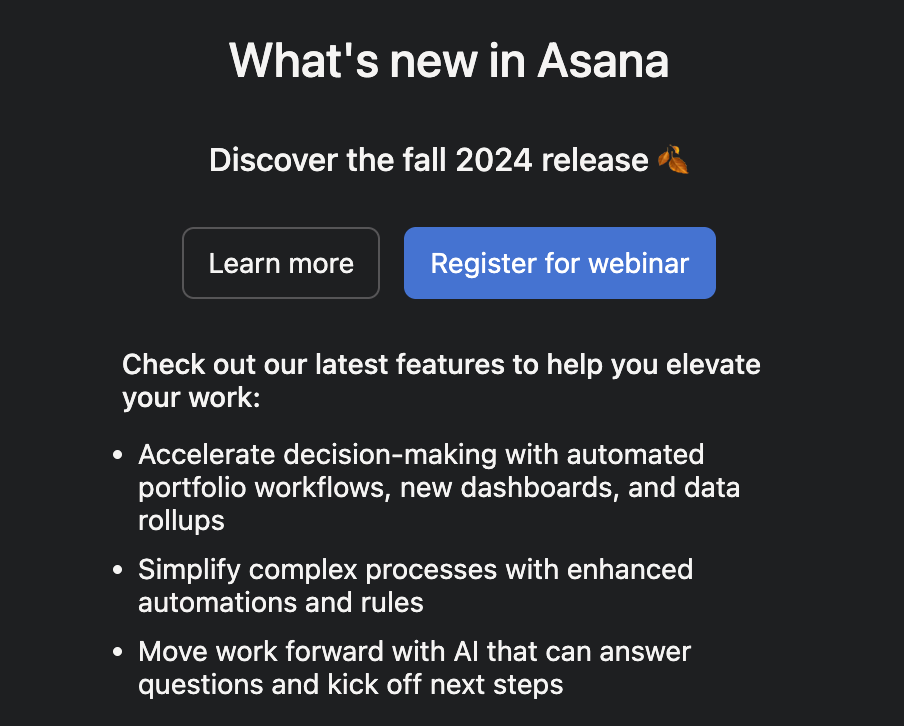
They have multi-modal tutorials and guides while utilizing tooltips and chatbots to assist users at multiple touchpoints.
-
Provide On-Demand Help
What’s faster and less expensive in the long run: contacting customer support for every little issue or accessing resources within or outside the application to help you when needed?
With on-demand help, users can access resources directly within the application, enabling them to resolve issues independently. This reduces reliance on customer support and ensures faster, more seamless problem-solving.
Providing on-demand help within the application is simple:
- Add a Centralized Help Center: Integrate a searchable help center directly into the application, offering access to FAQs, troubleshooting guides, and tutorials.
- Include Contextual Help Buttons: Place help icons next to specific features or fields where users will likely have questions.
- Enable Live Chat or AI Chatbots: Provide an integrated chat option where users can ask questions and get immediate responses from a live agent or an AI-powered bot.
- Allow Users to Flag Issues and Provide Feedback Directly: Add a “Need Help?” button within your application allows users to request assistance or submit support tickets without leaving the app.
After accessing help resources, prompting users to rate their usefulness, such as “Helpful” or “Needs Improvement,” provides valuable feedback for continuous improvement.
An example is Canva, at the bottom of every page to help users and flag issues before speaking to a customer success representative.
| Embed<iframe frameBorder=’0′ width=’640′ height=’360′ webkitallowfullscreen mozallowfullscreen allowfullscreen src=”https://www.awesomescreenshot.com/embed?id=34415711&shareKey=9a33058d4c4c781673895b51917dc158″></iframe> |
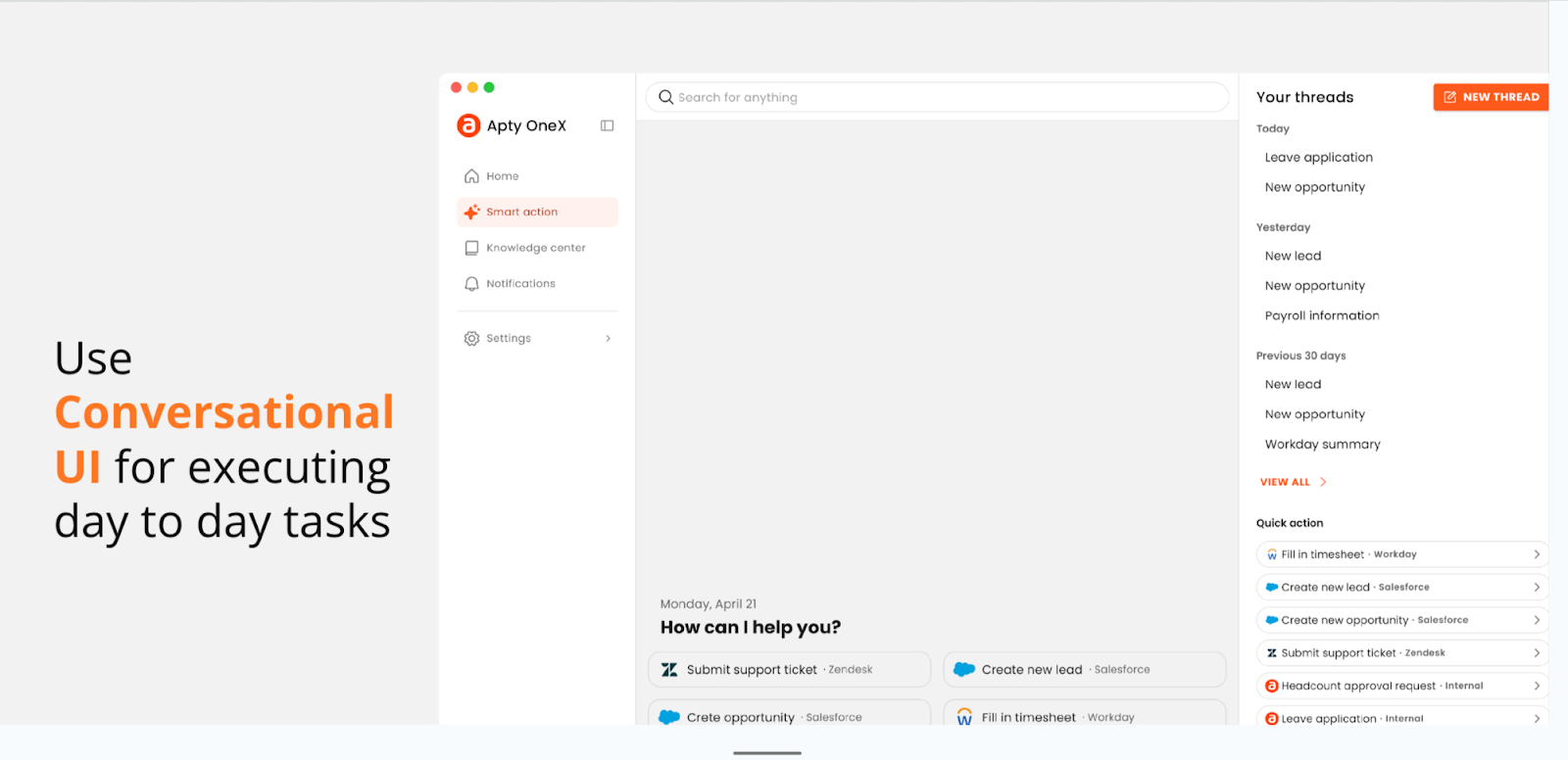
Apty helps build a centralized help center with Apty OneX, a powerful platform that connects users with all enterprise software in one place. It enables users to leverage AI to streamline task execution and provide on-demand assistance.
-
Tailor User Experience to Industry-Specific Needs
Different industries have unique onboarding requirements. To optimize your approach, research industry-specific best practices, identify compliance or regulatory needs, and analyze how competitors and peers successfully onboard their users.
For example, retail compliance focuses on tax regulations and payment compliance. For finance, General Data Protection Regulation (GDPR), Know Your Customer (KYC), Anti-Money Laundering (AML), Payment Card Industry Data Security Standard (PCI-DSS), and also global reporting standards like Basel III, Sarbanes-Oxley Act (SOX) for investor protection, and MiFID II. However, in hospitality, data compliance is less strict.
Apty helps companies implement data validation checks to enforce compliance rules among employees.
Onboarding differs by software type; for instance, the onboarding of Workday users varies greatly from that of Salesforce users.
In the AI era, software adoption success hinges on personalization and performance tracking. Apty combines the best of change management training, onboarding software, and predictive analytics to ensure every user journey is aligned with business outcomes.
-
Use Product Analytics to Measure and Improve Onboarding Experiences
Without analytics, key questions remain unanswered:
- How are users behaviorally using this software in their workflows?
- Is our onboarding and help content being effectively utilized?
- Are we optimizing the right processes during our transformation journey?
- When should we sunset an application or focus on better team training?
- How can we streamline contract management with minimal IT dependency?
Answering these questions is crucial for optimizing onboarding and measuring software return on investment (ROI).
Apty PULSE provides the answers.
As an AI-powered silent observer, it tracks user behavior, such as clicks, keystrokes, and navigation paths, offering actionable insights to improve productivity and reduce costs.
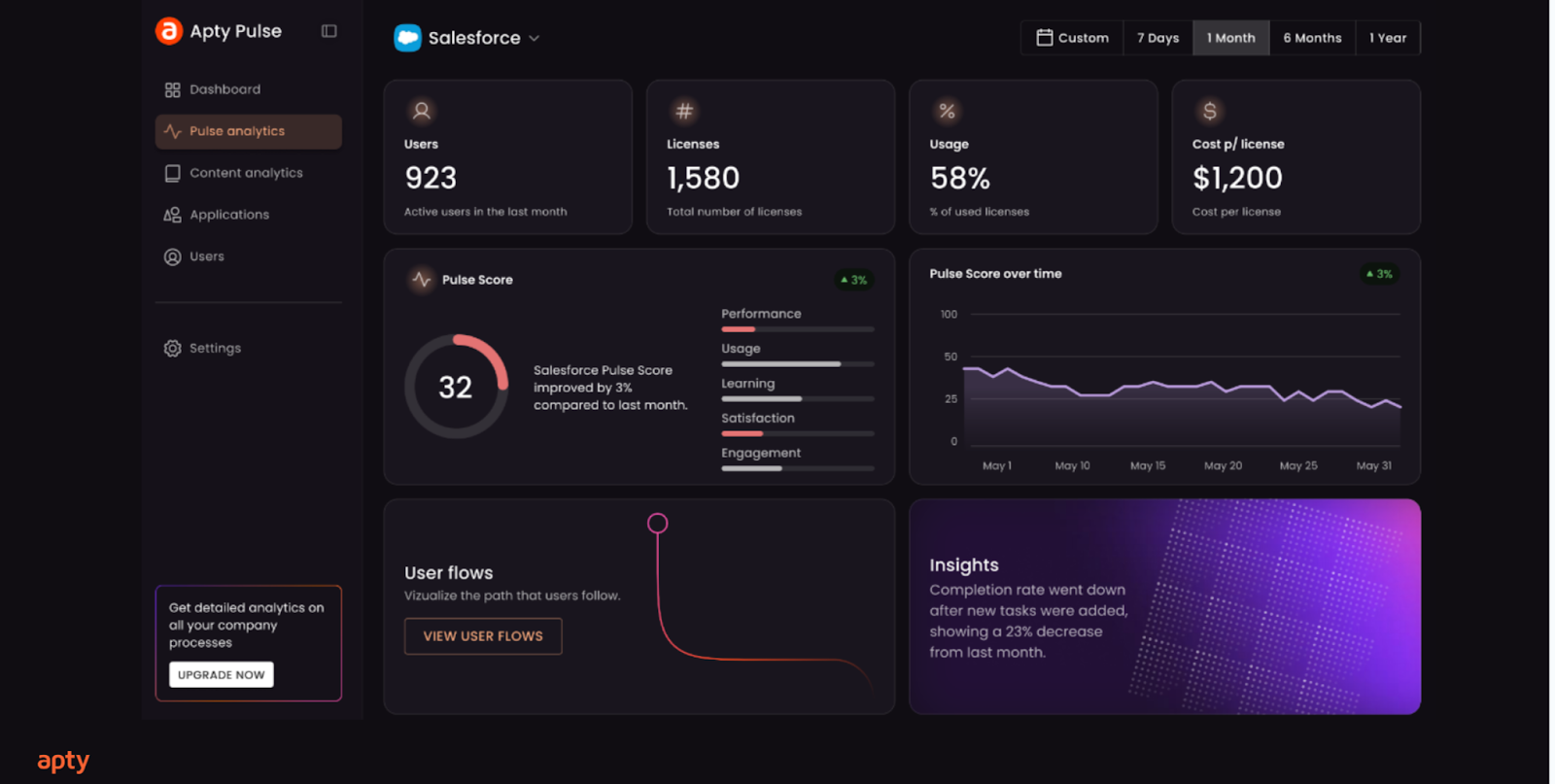
Key features include:
- Silent Monitoring: Tracks real-time user activity across apps, devices, and departments
- Productivity Insights: Identifies process bottlenecks and prescribes solutions (e.g., tooltips)
- User Flow Analysis: Visualizes navigation paths to optimize workflows
- App Utilization: Highlights underused apps, reducing unnecessary license costs
- Quick Setup: INSTALL > DIAGNOSE > PRESCRIBE delivers actionable insights in minutes
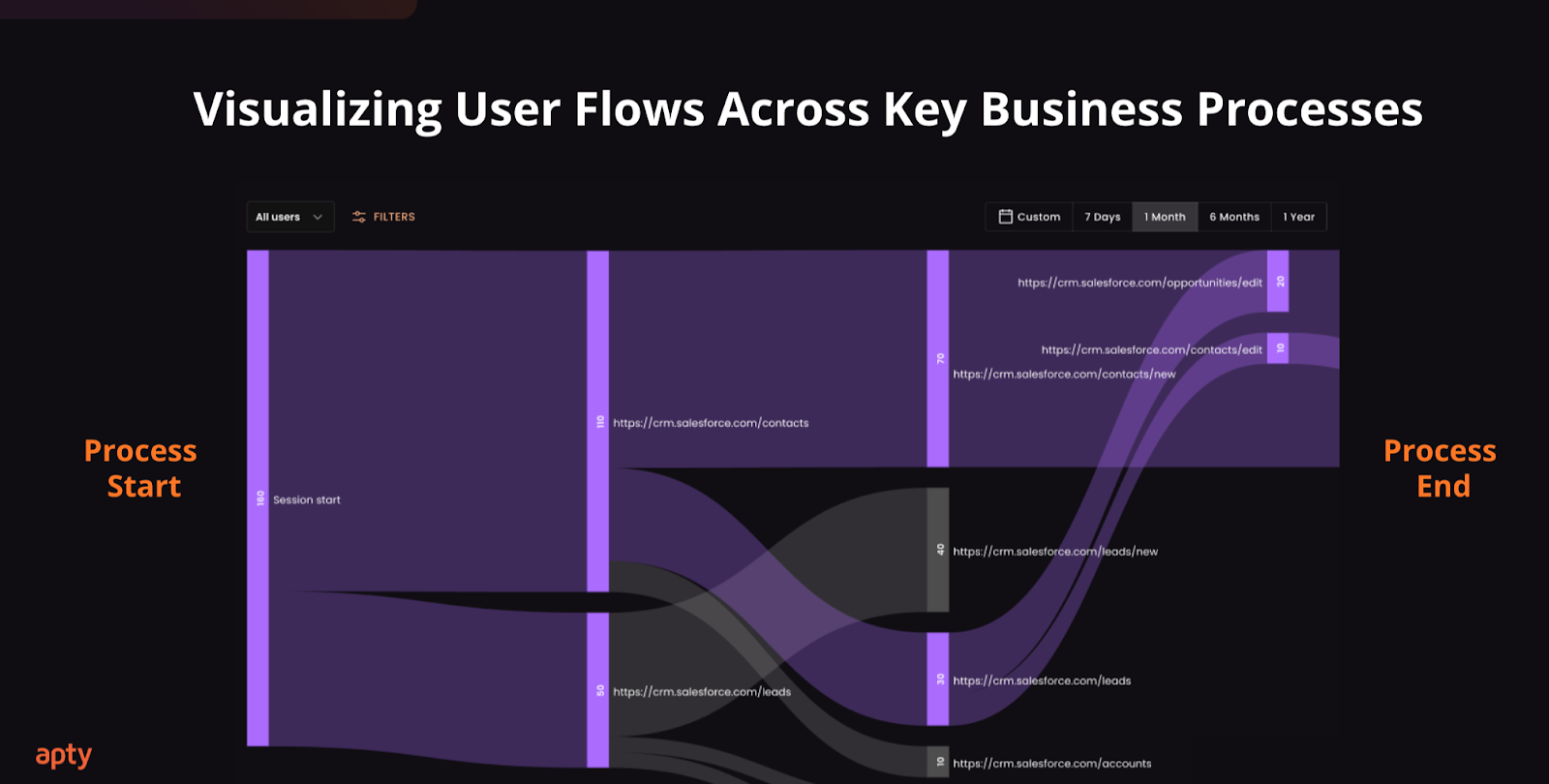
PULSE also tracks critical metrics like task completion rates, time to value (TTV), activation rates, content analytics, retention rates, feature adoption rates, user engagement scores, churn rates, and customer lifetime value (CLV).
Additionally, enhance onboarding effectiveness with:
- A/B Testing: Experiment across multiple scenarios to identify best practices
- Qualitative Feedback: Use surveys and interviews to collect user insights
- Continuous Iteration: Refine processes to improve user activation and retention
Onboard Users Better With Apty
$1 billion. That’s how much a leading global bank saved after using Apty to streamline its onboarding process and ensure compliance across international branches.
Traditional onboarding often fails due to forgettable training and lack of actionable insights, but Apty transforms the process with seamless integration and continuous optimization.
Here’s how Apty stands out:
- Rapid Deployment: Get started in 1-2 days with minimal IT effort
- Data-Driven Insights: Analyze software usage to identify bottlenecks, providing precise recommendations to improve adoption
- Contextual and In-App Guidance: Provide in-the-moment help tailored to user needs to boost engagement and productivity
- Automation for Efficiency: Simplify processes and reduce repetitive tasks
- Continuous Optimization: Doesn’t stop at deployment; it monitors and refines the onboarding process over time, ensuring ongoing improvement and higher ROI
- AI-powered: A predictive AI DAP that uses AI and ML to analyze software usage and adoption
With Apty, enterprises can deliver personalized onboarding experiences that drive adoption, productivity, and ROI.
Ready to experience the Apty difference? Book a demo today.
After spending cool cash on tools and training, you expect an ROI.
Yet users struggle, support requests pile up, usability complaints arise, and many revert to old processes. These are tell tale signs of poor digital adoption.
Proper digital adoption ensures users fully utilize and integrate company tools into their workflows, with minimal resistance. Without it, businesses face low software utilization, wasted investments, and process inefficiencies. Gartner reports only 14% of planning organizations have a digital adoption rate above 75%. This means more work is needed to improve digital adoption.
In this blog post, you’ll learn why digital adoption matters and how to make it work for your team.
What is Digital Adoption?
Digital adoption is the effective use of digital tools to achieve business goals. It ensures users maximize the value of all tools in their technology stack.
This goes beyond installation and basic features and empowers users to take advantage of all relevant features (basic and advanced) with minimal resistance. It helps increase productivity and crush business goals.
On the flip side, poor user adoption is risky. Here’s how:
- Underused tools waste resources
- Complex tools hinder productivity
- Reluctance to change obstructs future digital transformation
- Insufficient tool usage leads to missed opportunities for innovation
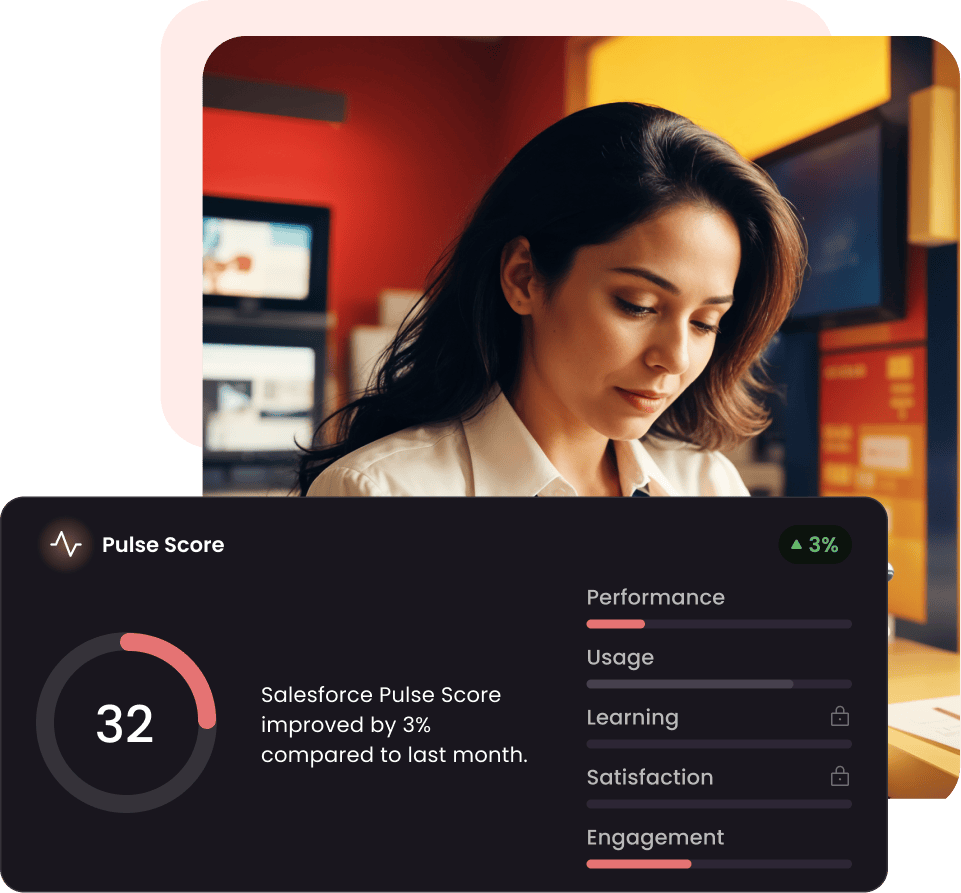
To overcome these challenges, many enterprises are shifting toward intelligent, AI-enabled platforms that not only guide users but also track adoption progress, reduce errors, and improve process efficiency. Solutions like Apty’s AI-powered Digital Adoption Platform (DAP) help businesses bridge the gap between software usage and business outcomes—by delivering contextual in-app guidance, identifying underutilized features, and enabling teams to adopt tools more confidently and efficiently.
| Type | What It Means | Example |
| Technology Adoption | Rolling out Workday HCM across the organization | The IT team sets up Workday and integrates it with other enterprise systems |
| Software Adoption | Using Workday HCM’s basic features for task completion | The payroll team processes salaries using Workday |
| User Adoption | Actively incorporating Workday into daily roles | Managers approve leave requests, and employees submit timesheets in Workday |
| Digital Adoption | Maximizing Workday’s features to optimize workflows | The HR team uses Workday analytics to forecast trends and plan hiring strategies |
Why Digital Adoption Matters
Digital adoption ensures we get value for our software investments. Here’s a case study that highlights why digital adoption matters:
A leading North American Bank implemented Clarity PPM software to improve project planning but faced adoption challenges despite support and training. Complex navigation, difficulty locating forms, and inaccurate data entry hindered productivity and raised return on investment (ROI) concerns for over a year.
They decided to invest in a digital adoption platform (DAP), to deploy digital adoption strategies like in-app guidance and multi-lingual support, and here’s what they gained:
- Improved visibility in banking operations
- Saved $275K on user adoption and training
- Reduced 30 days in user adoption
- Identified and resolved training roadblocks through analytics
- Ensured data accuracy with real-time validations
This study shows that digital adoption matters because it improves operations, boosts productivity, and actualizes software ROI.
Bain & Company reports that only 8% of companies say they are getting their money’s worth in terms of good business outcomes and advanced digital capabilities. Yet SaaS spend keeps increasing yearly.
5 Benefits of Digital Adoption
Here are five benefits of investing in digital adoption:
-
Increased ROI On Software Investments
Investing in digital adoption strategies like in-app guidance, walk-throughs, and on-demand help provides employees contextual, on-demand guidance that increases time-to-value. This also reduces the cost associated with traditional onboarding methods, leading to less money spent, shorter onboarding, and increased return on your software investments.
-
Enhanced User Productivity
When employees are comfortable with the tools designed to improve their workflows, they use the software as intended, complete their tasks, and spend less time troubleshooting. The result? Increased focus and productivity.
-
Improved User Experience
You know the frustration you feel when you’re trying your best to figure out something but it’s not clicking.
Wouldn’t it be easier to not experience that frustration and finish the job without struggle? That’s how digital adoption helps. Instead of endlessly searching through tutorials and manuals, DAPs provide real-time, context-sensitive guidance. It reduces frustration, enhances engagement, and improves the overall user experience with immediate assistance when and where needed.
-
Reduced Training Costs
Traditional training programs are often costly and time-consuming. Digital adoption helps to make use of those training materials the right way.
For instance, DAPs like Apty use smart rules to show users content based on their actions and roles. So, instead of going through everything, you get exactly what you need. Companies can then save on costly training sessions and avoid investing in materials that offer little value.
-
Stronger Change Management
Digital adoption simplifies the complexities of introducing new systems through clear, actionable guidance that reduces resistance to change. A supportive environment helps users feel confident navigating new tools and processes, ensuring smoother transitions and greater success in future digital transformation efforts.
How Do You Know When You Need Digital Adoption?
Wondering if digital adoption is the missing piece in your strategy? Let’s explore the signs that show it’s time to take action.
Low User Engagement With Newly Implemented Tools
Using feedback and analytics, dig into how employees use new tools, what features they use, and how they use them. You may need to invest in digital adoption strategies if you spot data entry errors, high drop-offs, low satisfaction scores, and short session durations.
High Employee Training and Support Costs
If you catch yourself maxing your training or support budget or if these costs exceed your software license fees, it could indicate gaps in your software adoption process. Calculate your total expenses and compare them to the value you’re gaining from the platform. Ask yourself—are the results worth it, and can you improve your ROI?
Increased Frustration or Resistance
Are support tickets piling up even after a few months of implementing a new tool? Ask employees (maybe anonymously or in groups) how they feel about the new software.
Resistance to new technology often arises from poorly managed transitions or confusing interfaces. When employees or customers express frustration, it lowers morale and slows productivity and satisfaction. Effective digital adoption strategies minimize these issues by offering step-by-step assistance and tailored training.
Underutilization of Critical Software Features
When only a fraction of your software features are used, you limit the value you gain from the software and your investment. A DAP like Apty identifies underused features and provides insights to help maximize tool utilization. This maximizes ROI and also improves productivity and user satisfaction in the long term.
Slow Realization of ROI
If you’re seeing a slow return on investment from your digital transformation efforts, it could be a sign that you need digital adoption. When tools aren’t fully integrated into everyday workflows or are underused, it leads to a delayed ROI.
Identifying this issue early and implementing a strong adoption strategy helps maximize the value of your tools, ensuring faster results and greater overall impact.
Common Digital Adoption Challenges
Let’s explore some common challenges in digital adoption and how to tackle them.
Here’s what gets in the way:
-
- Out-of-context training & onboarding
- Resistance to change
- Poor alignment between tools and processes
- Lack of real-time visibility
- Data silos and fragmented workflows
Out-of-Context User Training and Onboarding
Traditional adoption strategies lack context and are intensive. Employees are overwhelmed before they even get started. Time is also spent learning features and use cases that don’t match their job roles and functions. Structured and contextual training is needed to engage users and provide continuous support.
Resistance to Change
Change can be daunting. Users often resist new technologies because they’re comfortable with their current routines and fear how new software might disrupt them. This resistance can hinder the adoption of new technologies and slow down digital transformation efforts.
To overcome this, clearly communicate the benefits and reason behind the change. Provide ongoing support as well to guide users through the transformation, making the process less daunting.
Poor Alignment Between Tools and Processes
When digital tools and business processes are misaligned, they become more of a burden than a benefit. Imagine an agile team adopting project management software without Kanban boards, sprint planning, and task breakdown. They’ll struggle to adopt the solution, disrupting workflows and decreasing productivity.
Overwhelming Interfaces or Lack of Real-Time Guidance
Complex and confusing software interfaces can quickly frustrate users, which is why many businesses hire AI developers to design smarter, more intuitive user experiences. Without immediate, in-app assistance, users may give up entirely. DAPs solve this by providing relevant guidance within the application, making it easier for users to learn and use the software effectively.
Data Silos and Fragmented Workflows
If the new system doesn’t integrate properly with the current tech stack and workflow, employees may struggle to adopt the solution because it doesn’t feel like a part of their process. This also comes with constant tool or context switching and incomplete data-driven decisions.
Why Traditional DAPs Fall Short—and What Modern Solutions Do Differently
Most Digital Adoption Platforms focus solely on onboarding or helping users navigate tools. While helpful, this limited scope fails to address deeper business challenges like process inefficiencies, support ticket overload, and delayed ROI.
Modern platforms—like Apty’s AI-powered DAP—go further by:
- Delivering personalized, real-time guidance across complex workflows
- Reducing friction across the entire user journey, not just the first-time experience
- Capturing process-level data to identify where users struggle or drop off
- Enabling faster decisions through rich analytics tied to business outcomes
This shift from “user help” to “business execution” is what separates Apty from traditional tools. Organizations using Apty have reported:
- 30% fewer process errors
- 45% increase in completion of critical tasks
- 3.4x ROI in the first year
If your current DAP only solves for training, it’s time to look for a solution that delivers real business impact.
Key Strategies for Effective Digital Adoption
For organizations under pressure to improve workforce efficiency and tool utilization, Apty provides a low-risk, high-reward entry point. Unlike traditional platforms, Apty delivers measurable outcomes in days, not quarters—empowering leaders to start small, prove value fast, and scale confidently. Let’s dive into some key strategies that can make your digital adoption efforts more effective and help your team get the most out of your tools.
Identify and Eliminate Employee Resistance to Change
Employee resistance isn’t born out of thin air. There’s a reason it’s happening, and it’s keeping employees stuck and affecting their workflow. Here’s how to identify its root cause:
- Conduct anonymous surveys and interviews to gather feedback. Ask specific questions about their fears, anxieties, and suggestions.
- Observe employee behavior and physical interactions (if possible).
- Be upfront and honest about the reasons for the change, the potential impacts, and the timeline for implementation.
- Encourage dialogue and provide room for open discussions.
- Avoid answering questions vaguely to reduce doubt.
- Provide regular, clear, and consistent communication throughout the change management process.
- Include employees in the change process when possible.
- Use a proactive DAP like Apty to analyze your platform, gather user-level data, identify current bottlenecks, and deliver solutions to enhance software adoption.
Provide In-App Guidance and Support
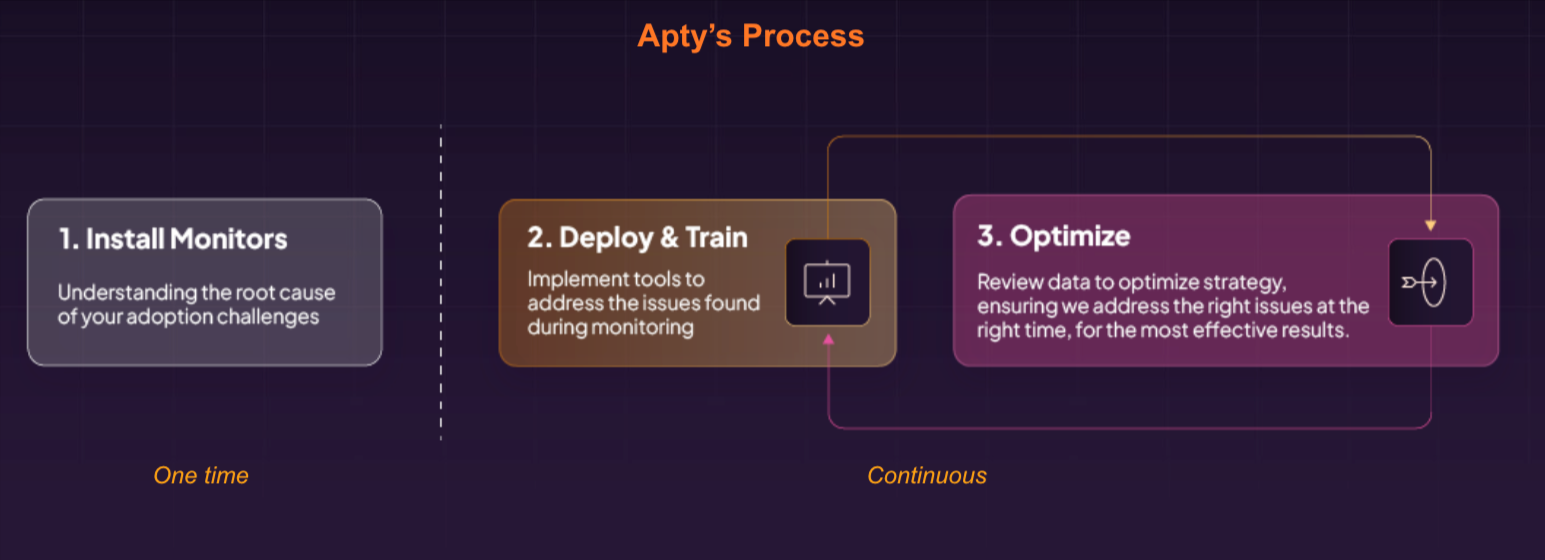
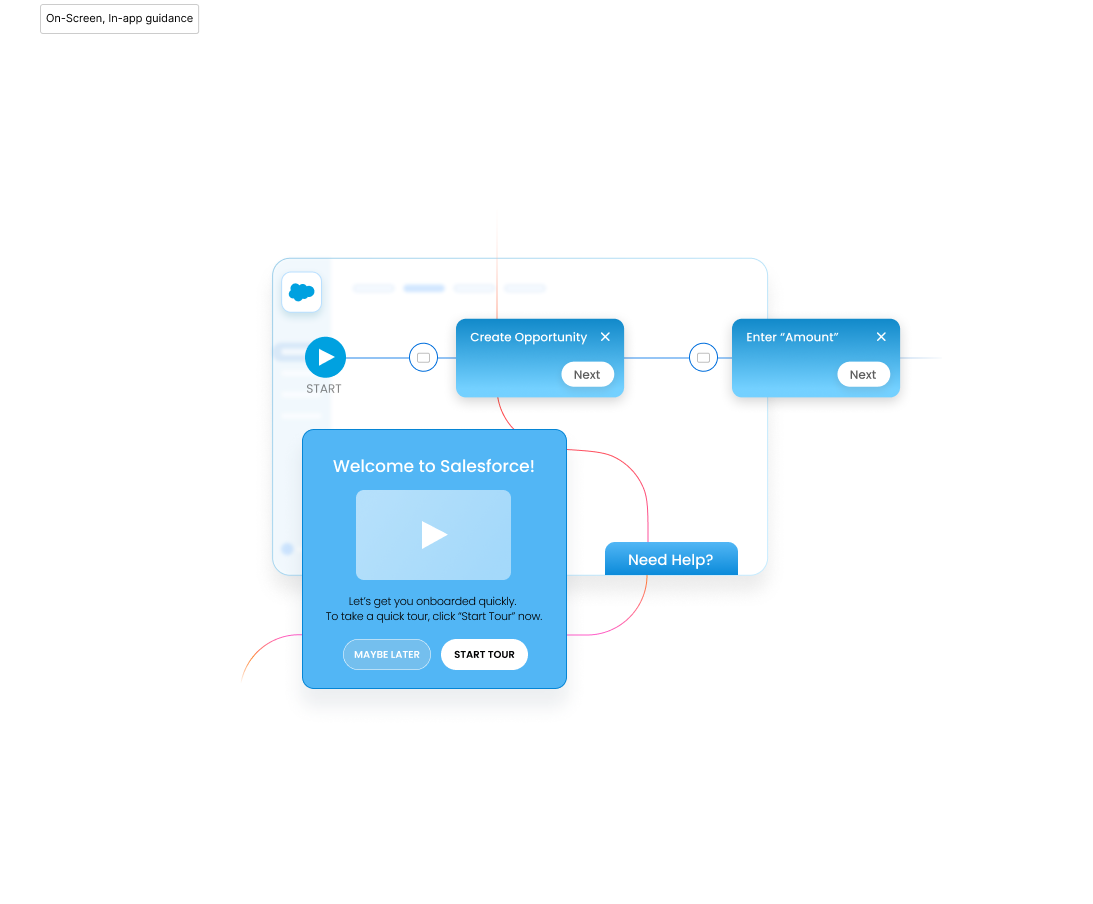
In-app guidance and support help employees when needed, reducing overstimulation and information overload. Employees can progressively digest information when they need support.
Using a DAP, you can offer step-by-step assistance directly on the application without interrupting their task. You can use checklists, pop ups, interactive walkthroughs, hotspots, contextual content management, and tutorial embeddings in relevant places.
Provide Self-Service Support
People generally prefer exploring a service themselves before reaching out for support. That’s where self-service comes in.
Self-service options, like searchable knowledge bases, chatbots, and FAQs, empower users to resolve issues independently. Like the ManyRequests example above, the chatbot is a self-service support feature that helps users troubleshoot.
Provide Personalized Training to Users
Avoid overwhelming users with information they can do without. Training is not a one-size-fits-all. Tailor training to their role and skill levels. Expert users shouldn’t receive the same content as beginners. What’s more, beginners in different roles also require distinct learning processes.
Create personalized learning paths with interactive elements and microlearning opportunities. Leverage technology, such as AI-powered tools and learning management systems (LMS), to deliver relevant content and track progress. Personalized training also includes language support for multiple languages.
Continuous Training and Skill Development
Tools are continuously evolving, and training should keep pace. Turn every training session into searchable gold with speech-to-text that auto-creates indexed transcripts, highlights key steps, and embeds them as on-demand guides, perfect for async onboarding. Schedule regular AI corporate training & workshops and ongoing learning programs to help users with:
- Tooltips for context and guidance
- On-demand resources with up-to-date information
- Announcements and popups to communicate changes and new features, then use in-app guidance to show users how it works
- Evergreen, product-led content to keep users informed
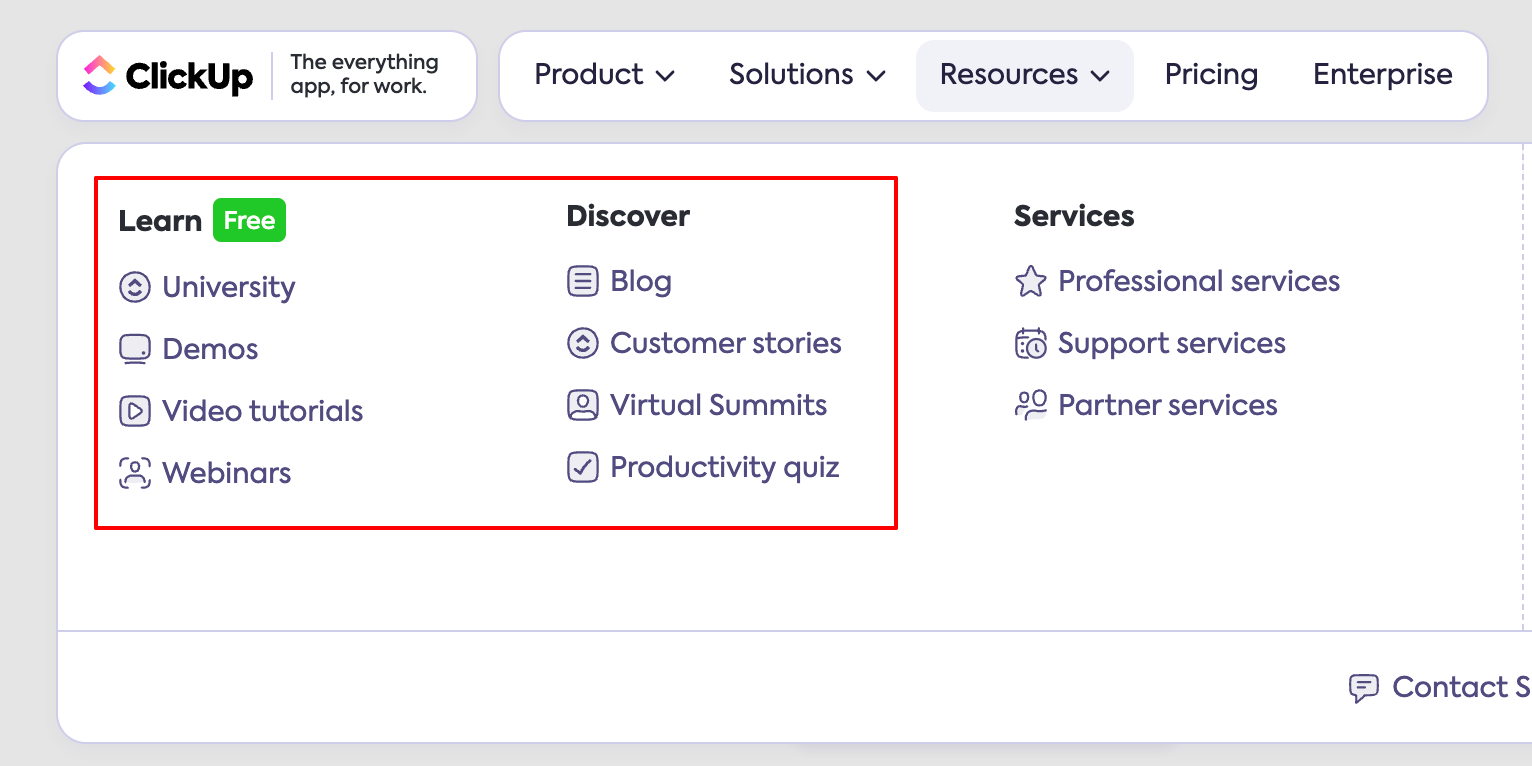
Companies like Salesforce, Adobe, and Microsoft have learning hubs and communities where community learning is encouraged and training resources are always up to date.
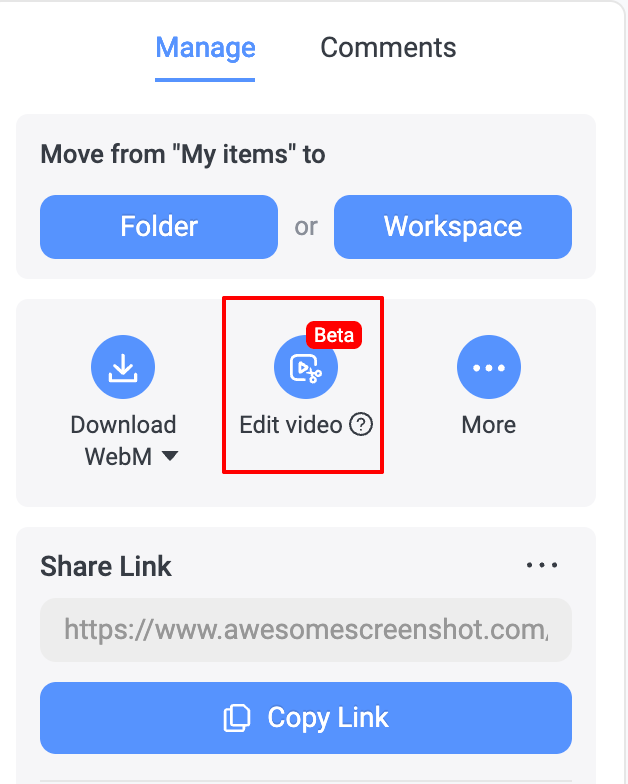
You can also use in-app toolkits to announce new features and train users on it. For instance, ‘Edit video’ is a new Awesome Tool feature and they show everyone (including power users) how to use it.

Provide Content in Multiple Formats
Everyone learns differently, and providing content in multiple formats and languages enables content accessibility and a better user experience. Use a mix of short and long copies, videos, and podcasts. Invest in DAP, which also supports multiple languages, making it easier for everyone to access regardless of preference.
Track User Adoption and Process Flow with Analytics
Analytics helps us answer the following questions:
- Where are the current workflow bottlenecks?
- Are we optimizing the right processes during our transformation journey?
- Are users using all the relevant features of the tool? Are they achieving true digital adoption?
- What tools are not used or underutilized and how?
- What’s the ROI of this software and its impact on operations?
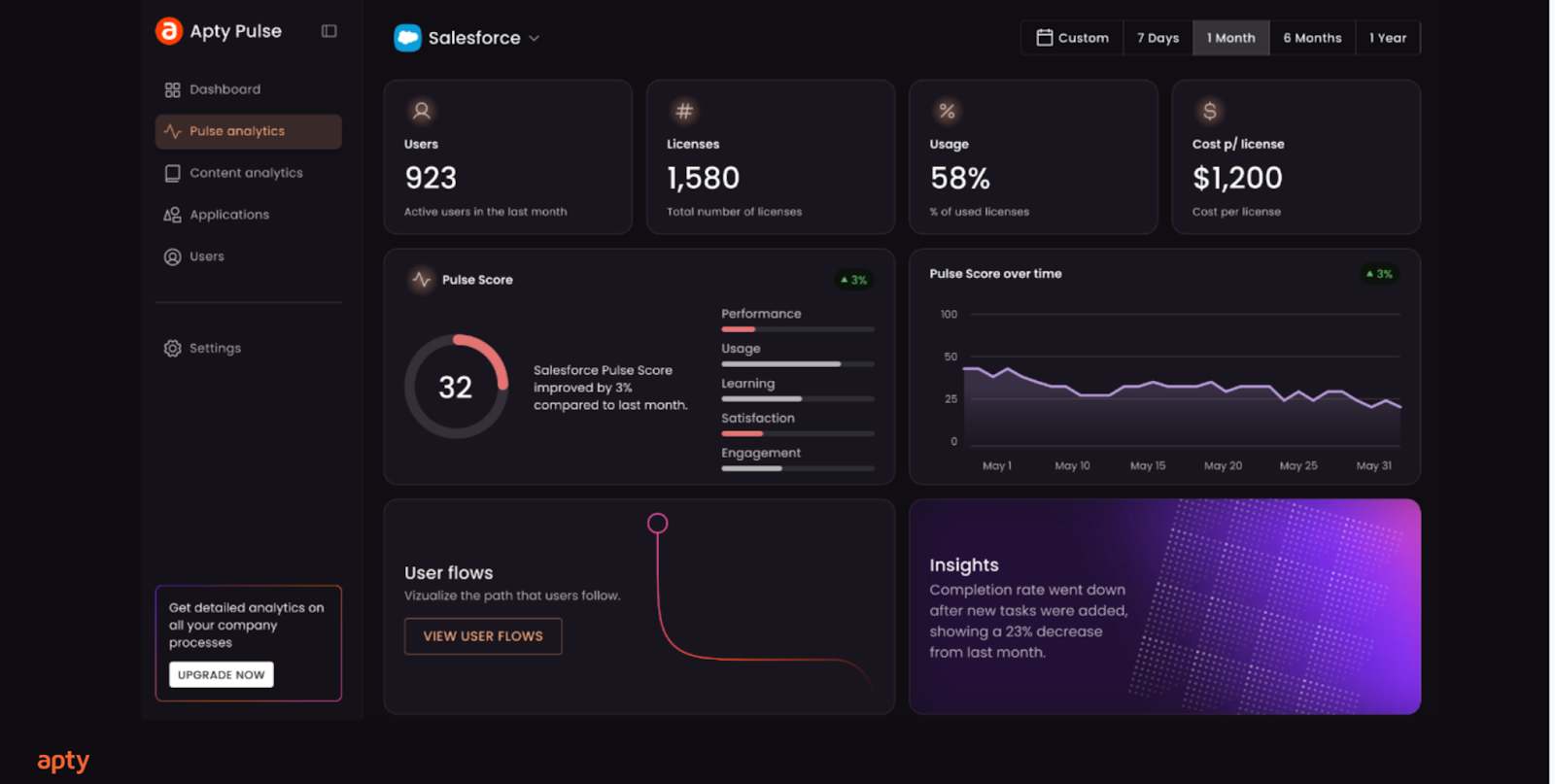
Apty PULSE provides the answers.
As an AI-powered silent observer, it tracks user behavior, such as clicks, keystrokes, and navigation paths, offering actionable insights to improve productivity and reduce costs.
Examples of Digital Adoption
Let’s look at some real-world examples of digital adoption to see how it works in action and the impact it can have.
- Enhancing HR Systems at Mattel
Mattel faced challenges transitioning to Workday HCM, leading to increased support tickets and inefficient onboarding. Mattel partnered with Apty to address this.
Apty’s solution provided interactive guides within Workday, empowering employees to learn and complete tasks independently. These guides were tailored to different languages and roles, improving onboarding and reducing support burden across Mattel’s global workforce.
Key Results:
- Rapid Adoption: 90% utilization of Workday within 60 days
- Reduced Support Tickets: Significant decrease in support inquiries
- Improved Efficiency: Employees completed tasks accurately and efficiently
- Enhanced Confidence: Senior leadership gained confidence in employee performance and software investment
- Better Project Planning at Global Bank
A leading North American financial institution implemented Clarity PPM software to streamline project planning. However, despite extensive training, users struggled with the platform’s complexity. This led to inefficiencies, errors, and increased support costs. They partnered with Apty, and here’s what they achieved:
- Step-by-Step Guidance: Interactive guides to walk users through complex processes
- Analytics and Reporting: Provided insights into user behavior and identified training gaps
- Reduced Support Costs: Saved $30,000 annually with reduced support tickets
- Accelerated Adoption: Onboarded users in just three months
- Improved Data Quality: Ensured accurate data entry through real-time validation
Digital Adoption Trends to Watch For
Let’s explore some digital adoption trends to keep an eye on and how they’re shaping the future of business.
Artificial Intelligence and DAPs
Gartner’s 2024 Hype Cycle highlights the growing importance of AI, with Generative AI and AI moving from hype to practical applications. AI-powered personalization in DAPs exemplifies this trend. Tailoring training materials and in-app guidance to individual user needs helps boost developer productivity and contribute to a positive ‘Total Experience’ for employees using new software.
Digital Immune Systems
Organizations are becoming more security aware as they adopt more digital tools. This leads to a shift from reactive and siloed security practices toward a digital immune system (DIS)—a proactive, integrated approach that safeguards systems while enhancing user experience.
A DIS is a proactive approach to ensuring the reliability and security of digital systems. It leverages AI, automation, and advanced analytics to:
- Detect and prevent threats: Identify and mitigate security breaches, software bugs, and performance issues.
- Enhance user experience: Ensure seamless and uninterrupted service for users.
- Improve business resilience: Minimize disruptions and maintain business continuity.
Gartner predicts that by 2025, organizations can increase customer satisfaction by investing in digital immunity and decreasing downtime by 80%.
Fuel Your Digital Adoption Journey With Apty
Apty is an enterprise digital adoption platform used by leading banks and brands like Mattel and Mary Kay to maximize the value of their technology investments. It enables you to:
- Provide in-app guidance using walkthroughs, checklists, and knowledge bases.
- Set up contextual learning using tooltips and smart rules.
- Learn within daily workflows, reducing disruptions and fostering task competition.
- Track user behavior, measure training effectiveness, and identify areas for improvement.
- Reduce the risk of data entry errors and increase compliance.
Ready to fuel your digital adoption journey? Book a demo today and discover how Apty can transform your adoption process.
FAQs
- What is the difference between digital adoption and technology adoption?
Technology adoption is the process of selecting, implementing, and training employees on new technologies. Digital adoption takes this further and ensures that these technologies are fully utilized to their maximum potential.
- How do I measure the success of digital adoption?
Gather employee and leader feedback on satisfaction, usability, and impact to measure digital adoption success. Use tools like Hotjar or a DAP to monitor behavior and platforms like Tableau to aggregate and analyze usage patterns across applications.
- How does digital adoption help achieve digital transformation?
Digital transformation means integrating technologies to reshape business operations. However, these technologies remain dormant without successful digital adoption. Digital adoption ensures users use tools effectively, driving innovation, efficiency, and true digital transformation.
4. How does Apty help reduce support ticket volume and improve IT productivity?
Apty’s AI-powered DAP provides in-app, real-time guidance that reduces user confusion and repetitive IT queries. This leads to fewer support tickets and allows IT teams to focus on strategic tasks.
5. What makes Apty different from other Digital Adoption Platforms like WalkMe or Whatfix?
Apty goes beyond onboarding by focusing on business outcomes like ROI, process efficiency, and error reduction. It delivers measurable results in weeks, not months, with cross-app insights.
6. Can Apty support enterprise-wide digital transformation initiatives across departments?
Yes. Apty scales across teams and tools, enabling consistent onboarding, compliance, and productivity improvements throughout the organization with role-based, cross-application support.
Product Walkthroughs are the key to unlock the full potential of your product to the world. But many companies are guilty of not utilizing them effectively to meet their customer’s expectations.
They go with one size fits all approach and create a product tour or product demo that gives unsatisfactory results.
This creates a negative impact on the efforts that your organization is taking to succeed in the market. Making your product adoption journey difficult results in an increased churn rate and poor retention rate.
An ideal Product Walkthrough solution should be contextual, and interactive which should ultimately help to increase the product adoption rate.
We put together a guide of Product Walkthrough to answer the most common questions about walkthroughs, including:
What is Product Walkthrough?
A Product Walkthrough is also known as Product Tour. It interactively guides users to realize the value and functionality of the product. They are the means to onboard new users or empower the existing ones.
Tours help your users to stay motivated and use your product properly. A good walkthrough should be valuable to users and help them identify how a new product can satisfy their needs.
Product Walkthroughs are not a one-time thing and can be utilized to introduce new or updated essential features to your users.
You can also customize your tours so that only specific features are shown in a product tour to a specific set of users. For example, you might create a tour that highlights premium features if you’re trying to upsell a user to the next subscription tier.
However, a feature walkthrough should be limited to a few relevant steps to get started. Once the user gets hang of your product environment you can go ahead to present other features when users are ready.
Why do you need a Product Walkthrough?
When a new user starts to utilize your product they usually encounter some kind of challenge. It creates a bad product experience and as a result, a user can drop-off.
Users must remain engaged and satisfied throughout the user journey. Businesses should keep them motivated by providing great user experience. You need Product Walkthroughs because they can help you:
- Make Users take action:- A new user needs guidance and providing them with interactive in-app walkthroughs does wonder. As a user need not leave your platform to learn about your product; they can learn by doing, thanks to interactive walkthroughs.
- Achieve better Adoption rates:- The product tour help users to achieve their goals immediately with fewer touchpoints. It reduces the learning curve. This makes users adopt your product seamlessly without being dependent on anyone. Which eventually increases the product adoption rate of your application.
- Increase Retention Rate and Reduce the churn rate:- Acquiring a new customer is 5 to 25 times costlier for a business than retaining the existing one. With a software walkthrough, you can retain the user and reduce the churn-rate. Reducing churn and increasing adoption improves your bottom line.
What makes a great Product Walkthrough?
A well-designed Product Walkthrough can determine the success of your product. Here are the few aspects that make a great product tour:
- Focus on providing value:- Initially, a user wants to see the value that your product can provide. To achieve this ask a few questions upfront to know what they want to achieve with your product. Once you know that guide them to achieve those goals as soon as possible.
- Keep it meaningful:- It can be tempting to showcase all the features to your users but doing so will overwhelm the user and they could drop-off. Show users the specific features they’ll find most important within a few-touchpoints.
- Don’t confuse the user:- Don’t show too many things at once, and never jump from one task to another especially when they are very different. Doing so could overwhelm and confuse your user.
- Mention the Next steps:- Once the user completes a task let them know what next steps they have to take. This is especially important when trying to convert free trials to active users. Leverage the end of a walkthrough to push to the next action such as making a purchase.
How Product Walkthrough can be Used?
Product Walkthroughs are one of the most powerful tools that SaaS products can use to pave their path to growth. Here are a few ways you can put Product Walkthrough to use:
- ntroducing new features and updates:- In-app guidance tools have an announcement feature which helps businesses to grab the attention of the user. It lets users know about the latest update and how to make use of it.
- Better onboarding experience:- When a new user opens the application for the first time, he could be confused and could find it difficult to start. Having a product tour in place guides users from one step to the other with the help of contextual walkthroughs and tooltips.
- Training new and existing users:- Most users aren’t going to sit through video training or want to read a bunch of help articles. So providing complete training via walkthrough on their own time using in-app guidance tools makes more sense. This saves a lot of time for the user in comparison to traditional training.
- Enabling sales:- A Product Walkthrough can begin from the moment a user visits your website and a well-built site backed by dedicated hosting ensures the experience starts smoothly. Use a walkthrough to guide users through your sign up process. It is an effective way to increase the conversion rate by creating a cohesive product experience across the board. It helps businesses to convert users into customers.
The product tour as a whole is helpful to boost your key business metrics. The product team should leverage walkthroughs to drive growth.
How to choose the right product tour tool?
A product tour or walkthrough tool guides users through each step by designing onboarding flow with tools like Tooltips, Announcements (Pop-up), and on-screen guidance.
The tools and software to create this content come under the umbrella of Digital Adoption Platforms (DAP) or Digital Adoption Solutions.
Selecting the right Product Walkthrough tool can be challenging. Having a basic tool could be helpful but for a more targeted user onboarding experience you must delve deep and go with a solution that offers mobility, flexibility, and customization.
Usually, companies must go with a product tour tool which offers the following:
- Walkthrough:- Step-by-Step walkthroughs are one of the basic things. It guides users from one step to the other seamlessly. Each of these steps could be highlighted in numerous ways. The main purpose is to let a user how to complete the step and what to do next.
- Tooltips:- These are generally available right next to a field. On Hovering over the icon which is right next to the field will give users the basic information about that field. It includes information such as:-
- Why the field is important?
- Why it is mandatory?
- Multi-Language-support:- Having support in multiple languages is essential as your user could hail from any country. It helps you to acquire new users from different regions and helps you to increase your retention rate.
- In-depth Analytics:- A modern Digital adoption solution helps you to get two types of insights:-
- Application Insights:- It helps you to understand how the user is utilizing your application.
- Workflow Insights:- It helps you to understand how the user is using the deployed workflow or walkthroughs.
- Customization:- Based on the insights available from the above steps a business can design their workflow based on each user type. Audience segmentation helps you to provide a customized onboarding experience.
How to Create a Great Product Walkthrough?
Traditional Digital Adoption Platforms are not capable of creating workflows based on user behavior. Product tours in legacy systems are created by assumptions made by the product team on what they think users need.
Creating workflows by merely using “assumptions ” is not an ideal way.
On the other hand, a Modern DAP(Digital Adoption Platform) like Apty does have capabilities to create a workflow based on each user type by understanding user behavior.
With Modern Digital Adoption Platform, you follow the DAP cycle which guides you to create a relevant onboarding flow-
- Application Analysis:- Understand how the user is utilizing an application this helps you understand their pain points and the issue that they are facing.
- Design workflows:- Based on the application analysis the workflows can be designed for each user type, this way you create effective workflows that a user will use effectively without dropping-off.
- Analyze workflows:- Once the designed workflow is deployed then you can analyze how the workflow is performing and then tweak it based on the drawn insights.
- Improve the adoption:- With all the data and insights available you can automate, improve, and build upon the existing workflows and make it more interactive.
What are the Benefits of using Product Walkthrough?
- Enhanced user engagement:- The user is hooked after their first interaction because of the Product Walkthrough. They go from one step to another, accomplish one goal after the other and all this contributes to a better engagement rate.
- Improved product adoption:- One of the biggest challenges is to enable customers to use your product. If a product is not used, then a SaaS company could lose their customer.
- Effective utilization:- In the long run, better utilization of the product is of paramount importance. A well-designed product tour that helps users to complete one task at a time and makes them realize their goals at their own pace ensures better utilization of the product.
- Decreased support-ticket:- Since the in-app guidance tool has all the relevant documents, knowledgebase links, videos, and walkthroughs. It empowers users to do the tasks on their own. It reduces the user’s dependency on any kind of support. It helps the organization to save costs and utilize their resources in a much effective way.
- Decreased churn-rate:- Once the user is able to properly use the product it helps the businesses to reduce the churn-rate as the users tend to use the application more often.
- Increased ROI on training:- Digital Adoption Platform helps you to save time and money by enabling your customers to adopt your application in less time. On-screen guidance quickly shows users how your product works and guides them towards mastering it.
Here’s how Apty makes Software Training simple, better and faster.
Dos and Don’ts
Here are a few tips that you can follow to get most out of your Product Walkthrough:
- Do align your Product Walkthrough strategy with the overall organization’s strategy:- This might appear far-fetched but it is essential to align your Product Walkthrough strategy with your overall organization strategies such as product adoption strategy, training strategy, customer experience strategy, customer success strategy, and sales strategy.
- Do co-ordinate across the board to get the walkthrough right:- Since the goals of the organization are aligned it is a must to involve important stakeholders to design a consistent walkthrough.
- Do understand your users:- Understanding users by analyzing product usage is important for creating relevant workflows for your user. Having irrelevant onboarding flow in place could hurt the user experience.
- Do create customized workflows:- Customized workflows created based on the data available helps the user to achieve the “aha moment” consecutively as the experience attached to it is personalized.
- Do Ask for Feedback:- Even if you can analyze all the flaws and merit of an application, it is always better to ask for feedback from a user. A real person could help you to know where your product stands and allows you to check the efficiency of the insights drawn by the digital adoption solution.
- Don’t set and forget the onboarding flow:- As onboarding, is a continuous process and the behavior of the user is continuously changing. Keep an eye on the analytics and update the workflow regularly. This doesn’t mean that you have to it daily or weekly. You can do it on a monthly or quarterly basis but the bottom line is to maintain the workflows and keep a check on them.
- Don’t make the workflow lengthy:- You can be tempted to make a new user see all the features in one go but doing so will overwhelm them as they can barely remember such an exhaustive experience with your product. Moreover, it will impact the retention rate. The best option would be to dissect your Product Walkthrough flows and segment them in an organized manner. It will help your users to absorb your product in a much better way.
Going Forward!
A Product Walkthrough is a great means to onboard new or existing users. It enhances the user experience and increases product adoption rates.
Look for a modern digital adoption solution like Apty that helps you to deploy the walkthrough without even writing a single piece of code. It saves time for your development team, training professionals, and customer support.
Modern software walkthrough solutions are one of the most cost-efficient ways for any business to train and onboard users.
Onboarding is the process through which new employees learn the information, skills, and behaviors to become effective and productive organizational members. It refers to the process of involving a new employee in the business and its culture. Employee onboarding is a phase between interviewing potential candidates and converting them into full-fledged employees.
Most often, Onboarding is confused with orientation while both are entirely different. Orientation is a “One-time” event to welcome an employee into the organization. Onboarding is a series of events and training to help employees with the day-to-day responsibilities of job roles and work processes. Onboarding focuses more on the job and team dynamics.
Let’s understand how vital your employee onboarding experience is.
According to BambooHR’s study, employees who feel a positive onboarding experience are 18 times more committed to their organization and reported 50% higher benefits utilization.
Clearly, creating an exceptional employee onboarding experience is key to empowering employees from Day-1 and driving the organization towards success. Here are the 4 best employee onboarding examples to include in your employee onboarding process:
- Gamification
- Keeping managers in the loop
- Focus on the long run rather than a short one
- Try out company products
A. Gamification:
A good employee onboarding process must be fun, playful, and informative at the same time. It makes newly hired employees get accustomed to the workplace without any pressure, and gamifying the onboarding process is one of them.
Gamification refers to adding components that make your employee onboarding process more fun, challenging, or motivated through various rewards. It gives the same experience as a video game, making the whole process engaging. It sets out goals to achieve, fun to make them pursue, and rewards to motivate them.
Let’s look at how Essar included gamification in their onboarding process.
Essar, India’s leading corporate delivering world-class services in sectors of energy, infrastructure, metals & mining, and in verticals of technology, has collaborated with Indusgeeks to make a 3D onboarding gamification solution. They gamified their onboarding process, resulting in increased productivity and higher profit.
Even if your organization has any financial constraints to make the whole onboarding process gamified, try to make at least a few phases of it gamified. This can help you ensure successful onboarding and improved productivity.
B. Keeping managers in the loop:
Managers play a vital role in the employee onboarding process but cannot always devote enough time. Employee onboarding is not only about paperwork, meets & greets. It is an initiative with several agendas to it. But taking things into their hands, managers must get involved in the process and ensure the new hires are familiar with it and feel at ease.
Let’s take a look at how Google is doing this:
Google is a company that focuses on Artificial Intelligence, Search Engines, Online Advertising, Cloud Computing, Computer Software, and more. Google leverages the method of including Managers in its onboarding process.
But taking things into their hands, managers must get involved in the process and ensure the new hires are familiar with it and feel at ease. These are a few aspects which a manager must do for the new hire,
- Match Noggler (Noogler is the affectionate term Google uses to refer to new hires) to a buddy on day-1.
- Encourage them to speak about potential issues, if any.
- Monthly check-ins during the first six months of the new employee.
- Set their roles and responsibilities.
- Have an open-door policy in the workplace.
By following this set of functions, google increased its new hire productivity by 25%.
C. Try out company products:
The new employees may be familiar with the product, but they may lack hands-on experience with that product. Make sure that the employee tries out at least significant products of the company so that they are familiar with it and at the same time may come up with a few suggestions that can help in the overall development of the product.
Pepsi is doing this here to ensure that its employees understand significant products.
Pepsi, an American multinational food, snack, and beverage corporation, ensures that all the new hires try out their significant products and give feedback. Based on their feedback, Pepsi makes corresponding improvements to the product and training procedures.
Also, Pepsi is into employee health and wellness. They provide them with food & drinks and fitness trackers to keep track of their health.
New employees are most likely simply thinking about your organization and product in the abstract on their first day. Everything else about the job might become blurry as a result of this. So, if you can get them to use your items right away, that will give them a better feel for what you’re talking about & give them a better employee onboarding experience.
D. Aim for the long run rather than the short one:
Without any fun elements, Onboarding can be complex. Make your employees learn about the history and core values of the company from scratch. Try creating a bond with co-workers through various activities, games & projects. Ensure the onboarding process is customized for every individual, from entry-level positions to seasoned veterans.
“The original motivation for doing it was to ensure that people were there for reasons beyond a short-term paycheck.”
Tony Hsieh, Zappos CEO.
Zappos, an American online shoe & clothing retailer, have decided to incentivize recruits by offering them $4000 to quit if they are not up for the job. Employees must question their commitment to the company and make sure to believe them in the longer-run.
Organizations don’t want their employees to quit in the initial months after Onboarding, as it costs a lot to hire a new one. Through this strategy, Zappos could enhance commitment and screen out individuals who are not culturally compatible at a very early stage.
Conclusion:
Employee onboarding is a continuous process, and getting it right is tricky. But organizations can strive to do better and create an onboarding experience that can make the employee productive from Day -1.
This is where Apty comes into the picture. Apty not only ensures seamless Onboarding but also ensures business process compliance. Therefore, the action performed by your employees within the application is in accordance with the organization’s guidelines.
Apty Analytics allows managers to identify where their employees get stuck and need assistance. You can create customized walkthroughs and announcements to guide your employees in the right direction and optimize the complete onboarding process. Apty ensures a 300% faster adoption, 40% increase in employee performance & productivity, and saves 80% of the training and support cost.
A Great User Onboarding Experience can spell long-term success for your business. In the same breath, it is wise to also acknowledge that a shoddy one can put your business in jeopardy.
The User Onboarding experience is your users’ first encounter with your product. This is why it is absolutely crucial that your onboarding process is impeccable and impactful.
Onboarding users effectively also helps you quickly drive them to their aha moment which, as we all will agree, is the goal. It also helps you improve activation rates and ‘free-trial to paid customer’ conversion rate. And these are just the initial benefits of providing a solid user onboarding flow.
Research says companies with a great User Onboarding experience have 50% higher new-hire productivity. Providing a smooth User onboarding is not easy. Many SaaS companies face difficulties in providing a smooth User Onboarding experience.
In this blog, we are going to focus on the 10 best ways that you can provide a great first product experience to your end-users.
What is User Onboarding Experience or UX Onboarding?
User Onboarding experience or UX onboarding is the process of making end-users experience aha moment while making them understand your product.
Why User Onboarding Experience is important?
Imagine, you suddenly waking up in space station. How many of us can claim to be at complete ease trying to figure our way through it? Almost none!
Likewise, when people start using your product, they will not be aware of what they should be doing.
So, it is your responsibility to make them understand how to navigate your product and provide them with a smooth User Onboarding Experience.
The primary objective is to make your end-users understand how to use your product or application. This helps your users to:
- achieve their goals & objectives
- realize the ‘wow’ moment
- understand the value of your product
How to Create the Best User Onboarding Experience? What are the Tips to Follow?
Here’re the 10 tips to create smooth & effective User Onboarding Experience:
- Be simple and contextual
- Give a good head start
- Provide appealing Welcome messages
- Create value for your user
- Put your users in driver’s seat
- Use a Checklist or Progress bars
- Set Objectives and Target Metrics
- Focus on Individual Personas
- Provide Product Tour
- Be consistent and predictable
1. Be simple and contextual:
The mantra in providing the best User Onboarding experience is to keep it simple.
Create the content by putting yourself in the shoes of your end-users. Introduce your product and explain to users how they add value to them.
Ask yourself…
- How complex is your product?
- How much time it will take to understand?
- How much have you invested upfront?
- What is the Return on Investment (ROI)?
- What is your user persona?
- How savvy your users are?
All these questions help you in understanding your end-users and to provide a smooth User Onboarding Experience.
2. Give a good head start:
Initial experience matters a lot. Make your first impression the best to have a smooth User Onboarding experience. Don’t dump too much information right from the get go. Provide the most important information that helps your users to achieve their primary goals.
Try to minimize the number of steps wherever possible and keep your Onboarding process short.
For example, let us see how Quora onboarding happens,
- Asks for sign up
- Select your area of interests
- Create an account
- Build your profile(optional)
- Explore questions
- Start Answering
Since there are only a few steps involved, Quora users feel very comfortable and engaged.
But SaaS companies might have complex products wherein users must go through many steps to understand the product. In that case, SaaS companies must give a good head start and make their users get what they want as early as possible.
3. Provide appealing Welcome messages:
Welcome messages are the User Interface (UI) element that visually separates your User Onboarding experience from the products’ interface itself.
Welcome messages are like a transparent layer that enables your users to peek into the main application. They not only motivate individuals to complete their onboarding but also keeps an eye towards their end goals.
There are full-screen takeover messages, which coves your users’ entire screen and make them focus on the message. This can be disruptive in some instances, can be used sparingly.
How to create Appealing Welcome messages?
- Start with a great sign-up process
- Set the right expectations
- Personalize the messages
- Establish a connection
- Develop Engagement with images & gifs
- Allow individuals to express their preferences
- Grant access to explore all resources
- Easy to identify the Call to Action (CTA)
4. Create value for the user:
The most important element in providing the best User Onboarding experience is creating value for your users.
First, remember your core value proposition and communicate that to your users. During the SaaS onboarding process, tell your users what’s in it for them & why your product or application is the best. Show them how they can meet their needs with your product at the earliest.
In the introduction phase of the User Onboarding process, they can learn highly essential features. It is good to let your end-users understand the significant features at the initial stage and learn the extras as & when required.
Ways to create value:
- Clearly define your Value Proposition (VP)
- Keep VP simple and easy to understand
- Make your first impression as the best
- Don’t include complex technical jargon
- Try to understand user pain points
5. Put your users in driver’s seat:
Let your users have control over the SaaS onboarding flow. Though it might sound strange, giving your end-users the liberty to skip some steps in the User Onboarding process engages them more.
The reason is simple. Not every user has the desire to follow the entire Onboarding process. Some individuals prefer exploring it by themselves rather than reading the information you provide.
For example, instead of going against the tide and forcing someone to learn, give them the option to skip certain steps. By doing this, you can get to know which step most of your users skip.
Now, if you find that a particular step creating confusion among users consider replacing it. Else, you can go ahead and start making engaging content to attract end-users.
6. Use Progress bars:
Progress bars help a lot in providing a great User Onboarding experience.A Progress bar acts as a visual indicator that tells you how far along you’ve come and assures you that you are on the right track can put anyone at ease.
Many SaaS companies use progress bars in their User Interface to engage end-users and to complete the onboarding process sooner. A progress bar also helps in reminding users that they haven’t completed the given task yet.
Also, you can start the progress bar at 20 or 30%, this indirectly motivates your end-users to feel like they have accomplished something.
For example, LinkedIn does this job perfectly.
LinkedIn progress bars clearly show how strong your profile is as you continue updating it. This progress bar helps you complete your profile step-by-step and keeps you engaged throughout the process. It also breaks down complex tasks into simpler ones, making the optimization process easier. For a deeper understanding of how to enhance your LinkedIn workflow, you can also explore this HubSpot LinkedIn integration guide to connect your tools and improve overall efficiency.
Used effectively, progress bars can provide a smooth User Onboarding experience. You can also use some other checklists to engage your users but make sure you leverage something like this to increase user engagement.
7. Set Objectives and Target Metrics:
Each step in the User Onboarding journey must focus on Value Creation, User engagement, and Product Adoption. To achieve smooth User Onboarding experience clearly define objectives, key metrics, and targets. Only if you have clear objectives defined, you can achieve success or desirable outcomes.
How does this help in providing smooth UX onboarding?
Once goals and metrics are set, communicate to your users and show them how their contribution will have an impact.
Frame your onboarding process based on your SaaS goals. Before rolling out the onboarding process, do A/B testing using the best ab testing tools. Try different approaches or processes and make sure you create customized UX for different user personas to meet their specific needs.
8. Focus on Individual Personas:
Persona-based User onboarding is the need of the hour. It helps your end-users have a great product experience with higher User Engagement.
For example, some of your new users might have a basic idea of what they need to do with your application or product. So, you need not waste your time in explaining things from scratch.
To avoid such situations, you can have different onboarding options based on personas wherein each one has a unique course of action.
Alternatively, you can create persona-based User Onboarding with the Digital Adoption Platform like Apty.
9. Provide Product Tour:
With the help of a Product Tour, you can show your users instead of telling them what they should do. The Product tour walks your users throughout the product and helps to create their moment of value at the earliest.
Product tours or walkthroughs pave way for smooth User Onboarding experience. It is like an experienced guide sitting with you and guiding you on the right path. Users feel very comfortable as they can get hands-on experience with your product.
Note:- A Digital Adoption Platform like Apty is a powerful walkthrough software which helps to create codeless workflows in a few simple steps. Also, Apty helps in User Onboarding, Product Adoption, and more.
10. Be consistent and predictable:
From start to end, you must make keep track of your product consistency. You must be consistent in the
- language & tone that you use in the onboarding flow
- progress bars or navigation icons
- other visual components
In short, be consistent in everything that users experience on your product.
Being consistent in your onboarding process will make your product’s navigation predictable to your end-users. This gives your end-users a clear picture of what kind of User onboarding experience they are about to get.
The 10 tips that we discussed above will help you to provide a great User Onboarding experience to your product’s users. Irrespective of the complexity of your SaaS product, you can leverage the Digital Adoption Platform to create smooth UX and UI to your end-users.
If you are actively looking for a tool, you must definitely try Apty.
Employee Onboarding challenges could hinder the growth of an organization. One of the fundamental responsibilities of any organization’s HR team and the respective managers is to ensure smooth onboarding of the new hire.
The major onboarding challenge is that companies focus think of onboarding as a week-long process at the most, post which they dust their hands off it and call it a day. Whereas, in reality, it is a long-term process and it can go from a few weeks to months until the employees feel comfortable in their role.
In fact, this stat puts things in perspective for anyone who is may assume that they have the new employee onboarding game all figured out.
“88% of the new hires feel that their organization does not do a great job of onboarding employees and there is room for improvement.”
The employee onboarding process should focus on reducing paperwork and increasing the employee engagement rate as it can boost the retention rate by 82% and productivity by 70%.
They say “The first impression is the best impression” is especially true when you are onboarding a new hire. You can potentially lose a great talent just because the proper process was not in place.
A scenario like this can be avoided by addressing the biggest employee onboarding challenges, and subsequently, proactively avoiding them.
Top Employee Onboarding Challenges
- Information bombardment on Day 1
- Lack of clarity on the role & expectations
- Assuming the new hire is up to date
- Right onboarding content for right roles
- Not familiar with the primary applications
1. Information Bombardment on Day 1
It is human to feel a little nervous, overwhelmed or even ecstatic on Day 1 of a new job. It’s a new workplace, new colleagues, the culture is unfamiliar, you aren’t very sure of your exact role, who your peers are going to be – It’s the adult version of first day at school, which we will all agree is a feeling like no other!
This being the case, it is insensitive to expect employees to absorb and retain all the key information about their new job, the company, its culture and everything else in between on the very first day!
In a fast-moving organization, you could be tempted to bring your employee up to speed as soon as possible but this could overwhelm them and could pose as an onboarding challenge. A new employee has tons of documents to fill, loads of names to memorize, multiple applications to learn, and in some cases huge shoes to fill. Achieving all this in a day or even a week is not possible.
For starters, you can automate paperwork with an electronic solution as part of Digital Onboarding. Doing so will help you to focus on other important onboarding activities and guide employees to seamlessly fill the documentation without any manual errors. Not just that, the documents are stored in the cloud which eliminates the risk of misplacement.
Relevant Read: Employee Onboarding Questions that Apty helps you Answer
2. Lack of Role Clarity
One common onboarding challenges during onboarding is that most new hires have lack of clarity of their role.
They usually think that they signed up for some specific role but doing something else. The new employee might be in a dilemma and could be disappointed by the assigned role.
It is the job of HR to ensure that team leads or managers meet with the new employees to discuss this. The discussion should give clarity to the employee, it must help them to understand how their current role will boost their career.
Relevant Read: Employee Onboarding Process – HR’s Finishing Touch
3. Assuming the newly acquired skills will stay relevant forever
You hire great talent and provide them with all the necessary skills to excel in their role, and Bam! You assume they will perform incredibly well for the rest of their life and stay with the company forever, right?
Wrong.
Even the brightest talent goes through a knowledge drain and it is your responsibility to ensure continuous learning by enabling on-demand, micro, and virtual form of training to reinforce the initial training.
Regular training will help your employee to be engaged in their jobs, reduce the retention rate, and will encourage them to stay with the organization for a longer period. It always better to have a checklist of things to have by your side while onboarding a new employee as it will help you to avoid assumption and overcome the new hire onboarding challenges.
Relevant Read: The Important Employee Onboarding Checklist that HR should follow
4. Right Onboarding Content for Right Roles
Onboarding flows should be tailored for specific job roles. Training everyone for everything is not judicious and is definitely an overkill.
For example, Joe is hired for sales. He should be trained on how the product that he is going to sell works. But he shouldn’t be trained to customize the product, it is the job of the Developer.
The same analogy applies to all the applications and processes for which the new employee will be trained. The Onboarding process should be relevant to the new employee and they shouldn’t feel overwhelmed.
Providing them with unnecessary information could suggest that the organization wants them to do other jobs as well and could lead to a lower employee retention rate.
Delve Deep: Best Practices of Employee Onboarding
5. Employees aren’t familiar with All the Applications
35 job critical applications are used by employees for over 1100 times in a day based on Pega Research.
Let me drop another bomb.
100% of the employees who participated in this research are humans.
When your workforce has to use so many applications, it becomes challenging to train employees to master all of them. And expecting them to know how to use them all instantly is unfair. Training and Onboarding the new employees on all the applications is practically impossible and is a waste of time, money, and effort.
It is ideal if the employees can be guided with relevant documents, videos, and on-demand Walkthroughs that can be accessed by them as and when required. It will reduce their dependency on HR, L&D, Managers, and colleagues as they can become self-sufficient.
Apty is a modern solution where each employee is contextually guided within the application with the help of walkthroughs and relevant resources. It reduces dependencies and help you overcome onboarding challenges.
Digital Transformation in banking has accelerated greatly in the recent past. The industry has seen an immense technological intervention and is empowered with the latest to provide the modern-day customer with the ideal, integrated experience.
But it still has a long way to go before it can reap the benefits of complete tech transformation.
A sector as big as banking would take time to shift its Digital Transformation efforts to meet current norms. Just the sheer number of banks that exist dictates that for change to occur at the micro level is a herculean task. And the digital infrastructure needed to manage employees remotely or otherwise is no easy feat, either! Which means, it will be a while before the industry undergoes transformation.
In this article, we will be discussing the three pillars for successful Digital Transformation in the banking industry. But before that, let’s take a quick look at the basics.
What is Digital Transformation in Banking?
Digital Transformation in banking is about how financial institutions interact with their customers and shift their view from product-centric to customer-centric.
It begins by understanding the requirements, aspirations, behaviors, choices, likes, dislikes of both employees and customers.
Since we know Digital Transformation is a complex process and even more so for a monolithic sector like banking, here are 3 factors that must be considered to enable Digital Transformation in banking and make most of it:
Digital transformation examples in banking
The most common digital transformation examples in banking are listed below:
a. Artificial Intelligence (AI)
The use of AI-powered tools can often provide significant improvements in the efficiency of banking operations by streamlining a wide variety of processes like customer support, and when combined with technologies like big data analytics, this can often help support decision-making thereby leading to better lending decisions and risk management.
b. Robotic process automation (RPA)
With the use of technologies like Robotic Process Automation (RPA), banks can use customer service bots to deal with low-priority inquiries from customers like payment queries, account balance checks, etc. thereby helping them to improve customer satisfaction with quick services, as well as lower operational costs and the probability of errors.
Other transformation examples in banking include cloud computing, big data, blockchain and more. Each organization must prioritize transformation activities based on its own business objectives as part of the strategic planning process. The integration of data, advanced analytics, and digital technology into all sections of a financial institution, changing the way work is done, priorities are defined, and services are delivered
Benefits of digital transformation in banking
Digital transformation in banking sector will reduce the number of mistakes made by bankers because the results will be more accurate with digitization. It may seem expensive at first to shift towards digitization, but the cost-effectiveness over time will be significant.
The following are common benefits of digital transformation in banking:
- Reduced customer waiting time
- Increased transparency and trust
- Improved customer engagement
- Personalized customer experience and
- Improved customer satisfaction and retention
Importance of digital transformation in banking
Digital transformation in the banking industry is necessary because it is what allows financial institutions to better learn about, interact with, and satisfy customers’ needs. For instance, the implementation of cloud computing in banking helps to promote safe online payments, digital money transfers, etc.
Moreover, by leveraging cloud-based services, financial institutions are also able to effectively save on capital expenditure as well as operating expenditure, all while ensuring customer data protection.
With digitization, companies can collect helpful insights to help them understand what people want. As such, they can tailor their services to meet customer needs rather than relying on guesswork. The technologies can also improve customer experience, improving engagement and communication.
3 Pillars for a Successful Digital Transformation in Banking
1. Digital Transformation to Enhance Customer Experience
The e-commerce space is rapidly moving towards frictionless experience and so is the telecom industry. But unfortunately, the banking industry is lagging.
If the banking sector wants to get the same level of success with their customers, they should focus on replicating the user experience model of the retail sector. Banks investing in comprehensive mobile banking development can create seamless user experiences that rival leading e-commerce platforms.

One of the digital transformation challenges in banking is to create a cohesive experience as there are a variety of functions that a bank performs, across different departments for a variety of customer segments.
According to our in-house Digital Transformation Consultant, Joseph Christopher, “ The future of banking depends on how effectively the Digital Transformation is planned and how those efforts facilitate omni-channel experience to their consumers.”
The trend is changing at a steady pace as people are comfortable using technology for their financial transactions.
Even though services like opening and closing bank accounts, reporting online fraud is done through branches, the shift towards the online medium is unavoidable.
Let’s try to understand the trend.
55% of the customers would be comfortable using a technology company like Apple, Google for a variety of financial transactions.
30% of the retail bank clients have a digital-only account which indicates that people are familiar with tech and prefer to receive service online.
Just providing internet users with an online experience is not enough to create an unforgettable experience. Rather, banks must focus on creating a consistent experience across online and offline channels, and across all devices and branches.
The infrastructure to process consumer data and understand their needs plays a vital role in creating a personalized experience. 75% of the consumers appreciate if a company can provide them with a personalized experience, based on their past purchase, transaction history, and most important of all, their name.
In short, to realize successful Digital Transformation, banks must focus on omni-channel, personalized, and cross-platform experience for their customers, and to do that their employees must be prepared with the tech that they handle.
You might find this article helpful – 7 Best Practices for Successful Digital Transformation
2. Digital Transformation needs an inside-out approach
Digital Transformation may sound like something technical and way more complicated than it is. One of the biggest digital transformation challenges in banking is to cultivate a mindset that welcomes change.
To execute the transformation successfully, companies need leaders who believe in innovation and also the entire organization’s buy-in. Technology is equally available for all; but what sets apart the leaders from laggards is the will to change.

First, enable change within the organization by bringing in new technology and processes that your employees can leverage to execute their job efficiently. Don’t go all guns blazing in one go; rather test the waters first and start with a business function that is important but not critical.
With time if you are able to see success, then gradually enhance your Digital Transformation efforts. Moreover, this approach must be opted to improve the business process, tech stack, and customer, experience with each wave of Digital Transformation within the organization.
It also helps you test multiple iterations in different test groups to find the perfect fit for the organization. Once you are comfortable with the initial execution of your Digital Transformation efforts, you could easily scale your transformation initiatives for your consumers as well.
Further, your employees would be in a better place to manage the change that impacts the customers and guide them through it.
Digital Transformation is a long process that can be improved, and optimized on a trial-and-error basis.
You may find this Case Study interesting: Mary Kay Digital Transformation Journey
3. Modern Tech Stack is required to Enable Digital Transformation
Investing in the latest tech stack is a must to stay ahead of the competition, exceed customer expectations and set new trends for the industry.
New technologies must be leveraged by the big banks and financial institutions to compete with smaller institutions who are far more agile in leveraging latest tech solutions to make the life of the customers simpler and better.

The same approach must be adopted by big financial institutions as well. The added advantage that the big banks have is the trust factor that smaller companies lack.
The technologies that enable Digital Transformation in the banking sector are:
- Blockchain: It is much more than cryptocurrency. Today, blockchain is utilized as a distributed ledger tech which is used for creating contracts, loans, and also for the simplification of transactions.
- Internet of Things: IoT in banking will help to enable the transaction between two inter-connected devices that communicate for payment and more.
- 5G: Today, customer experience is at the core of all businesses and so is their time. The advent of 5G will ensure that online transactions happen at a lightning speed and enable functions that were previously not possible to execute with 4G.
- Mobile Apps: Mobile apps enable users to enjoy the products and services of the bank from anywhere. From transferring money to applying for a loan, most things can be executed using mobile. To ensure these apps are reliable, secure, and updated seamlessly, banks will need to implement mobile CI/CD pipelines, combining the power of 5G and mobile to provide a simple yet holistic user experience.
- AI: AI helps banks to understand their customers and predict their financial strength, based on the current flow of money within the savings account and the past loan history of the client. Based on these and other data points, the AI decides whether any new loan can be sanctioned to the customer or any new investment fund can be recommended.
- Automation: It helps to provide answers to the regular customer queries which usually need minimal human intervention. Both AI and Automation help banking professionals to invest their time in more productive tasks.
- Digital Adoption Platform: Training employees on new technology could be difficult and more importantly time-consuming. To counter this problem, modern technology like Digital Adoption Platform can be used which helps your employees learn and use any web-based application from day 1. It guides each user group contextually from one step to another to help them accomplish their tasks without any prior training.
Wrapping It Up!
The journey of Digital Transformation in banking is quite long. While other sectors leverage latest technologies to create an incredible customer experience, the banking sector still lags. It is time to adopt new technologies and focus on a more people-centric approach to make your digital transformation initiatives effective.
Find out how investing in a cutting-edge like Apty Digital Adoption Platform can help you to realize value out of your efforts in no time at all.
The telecom industry has changed and will continue to evolve, heading into 2022. With the acceleration of IoT and 5G, telecom is undergoing a digital transformation in both technologies powering the industry and guiding how they interact with customers.
The COVID-19 pandemic accelerated digital disruption that was already in motion, creating the need for customer-focused services and greater efficiency.
Structural changes in the industry are centered on creating new value and ensuring that communication and content services become digital.
Digital Transformation for the telecom industry
According to the statista report, about 1,595 billion U.S. dollars is forecast to be spent globally on telecom services in 2024.
Digital transformation in telecom is highly important to improve their business outcomes, increase operational efficiencies, and provide ultimate customer experiences. It is the process of incorporating the latest tech to drive organizational growth and gain a competitive advantage.
Top Digital Transformation Trends to look for in the Telecom Industry
- Artificial Intelligence
- 5G Network
- Internet of Things
- Robotic Process Automation
- Big Data
- Cloud Computing
- Cyber Security
Trend 1: Artificial Intelligence
Artificial intelligence is well on its way to becoming one of the most sought-after technological resources, used in a number of popular tools, such as chatbots, virtual assistants, and customer satisfaction. With AI tools, data can be both processed and analyzed in incredibly large amounts to make service more effective and increase profit.
There are several ways that artificial intelligence can assist and optimize the telecom industry. AI will enhance digital transformation in predictive maintenance, network maintenance, customer service, and security.
Trend 2: 5G Network
The efficiency of wireless networks is becoming more critical as people become more dependent on mobile devices. This is why so many telecom companies have been investing in and preparing for 5G.
5G networks provide the fastest data transfer out there while offering high speed and low latency. 5G is already being used in healthcare, education, and transportation settings. In 2023, telecom will continue to develop new ways to bring 5G to the masses, providing the most efficient network for the public.
Trend 3: Internet of Things
The Internet of Things is driving digital transformation in telecom sector in two ways. First, as internet-connected devices become more popular, it increases the need for fast and reliable connections.
Secondly, utilizing the IoT creates ease for telecom providers to monitor the various communications bases remotely. IoT enables service providers to provide greater means of communication between devices and people.
Utilizing the IoT ensures the highest level of efficiency, seamless business processes, and increased revenue. In 2023, providers will continue seeking new ways to use the Internet of Things in various industries, including energy, technology, and healthcare.
Trend 4: Robotic Process Automation
Robotic Process Automation is being used for repetitive tasks and processes, enabling ease and agility for report generation, price tracking, back-office tasks, as well as responding to customers.
With RPA solutions, employees can focus on essential functions that require their attention while leaving rote tasks to automated technologies.
Trend 5: Big Data
Due to the Internet of Things, companies can work with enormous amounts of data in technological devices. This means that in 2023, they will need to control this data, move it from device to device, and support it safely.
Discovering solutions to control this data is becoming an essential task for both telecommunications companies and their customers.
Trend 6: Cloud Computing
Migration to the Cloud is happening in droves, as nearly every business is becoming aware of the benefits of Cloud-based services, especially in light of the increase of remote work due to the COVID-19 pandemic.
These benefits include less of a need for computer resources, streamlined processes, and organization, as well as lower costs. Telecom companies should invest in the infrastructure for delivering and supporting more cloud-based solutions.
Trend 7: Cyber Security
Cybersecurity is one of the most essential aspects of the telecom industry. This is because cyber crimes can be easy for hackers to commit, stealing sensitive private data of businesses and their customers.
As breaches become more common, telecom companies should expect their customers to ask how they’re making their data and networks more secure. Expect companies to make more significant investments in protecting their resources, detecting threats, preventing attacks, and recovering if the unthinkable happens.
Trends Highlight the Need for a Digital Adoption Platform
Each of these trends will change how telecom companies and their customers do their business. Dealing with the process changes caused by new technology is where a digital adoption platform can be a huge benefit.

Digital Transformation in telecom sector involves showing people how to use new technologies and proactively pushing them to complete new processes. Apty is designed to do both.
Here are some of the ways Apty can help companies with digital transformation in the telecom market:
a. Project and Portfolio Planning
From expanding 5G service to enabling more cloud services, telecom companies are managing large projects in 2022. But it’s hard to make accurate plans and decisions if you’re not tracking your progress or can’t trust the data you have about your progress.
Apty’s tracking tools can help you detect when a process isn’t being completed and nudge users to provide important updates. Apty’s validations also ensure the data that goes into the system is accurate so you can make timely decisions and how to move forward.
b. Customer or Employee Onboarding
As you introduce new or updated technologies, you have to make sure your customers and employees can use it. Apty’s step-by-step on-screen guidance helps people master new applications and processes quickly.
For employees, this is especially helpful when your workforce is remote. When you’re not in the office, you can just ask your cubicle neighbor how to do something.
c. Change Management
Managing that change and the processes around it can be overwhelming. Apty’s tools allow companies to quickly implement changes without costly and time-consuming training initiatives.
Benefits of Digital Transformation in the telecom
The following are the benefits of digital transformation for telecom companies,
- Improved customer experience
- Accurate Data-driven insights
- Agile network
- Process automation
- Quick sales conversions
Key digital technologies used in the telecommunications industry
One of the biggest breakthroughs in the telecommunications industry for digitization was the advent of big data and big data analytics to make more accurate predictions and actionable insights. Big data can enable providers to prepare their networks for future demands.
Businesses can take advantage of the available information at their disposal through big data and they can make their networks robust, optimized, and scalable by analyzing network traffic in real-time.
Business Intelligence (BI) tools can offer the interpretation needed to make sense of all that data. BI allows telecom companies to analyze customer needs and tailor them all to meet their requirements. Thus, telecom companies are widely using BI tools like Tableau, Power BI, and Cognos for predictive analysis, data mining, and forecasting.
Other key digital technologies used by telecommunication companies are 5G networks, the Internet of Things (IoT), and cloud computing. These technologies are helping to enable new services and business models, ensure faster communication, improve customer experience, and reduce costs.
What are the challenges to the digital transformation of the telecommunication sector?
The telecommunications industry is in the midst of a digital transformation as it moves to capitalize on new digital opportunities. Telecommunications companies must overcome several challenges like data governance issues, skills shortages, siloed systems, and employee resistance to change. Addressing these challenges will be critical for success in the digital age.
One of the challenges the telecoms face with digitizing is providing their customers with fast and responsive customer service. Sometimes the sheer volume of incoming calls is too much and providers aren’t prepared to handle it all the time.
Remote working opportunities have been on the rise since the pandemic began, and organizations started facing a new set of challenges to build a centralized work model wherein the data can be made accessible to every employee.
Cloud computing and IoT allow the telecom industry to reach new heights of development and growth but the proper collaboration of these technologies remains a hurdle. Businesses all over the globe must figure out efficient ways in which technologies can be used to upgrade existing processes and systems.
Telecom in 2023
As society moves into the future with more effective digital tools and faster technology, businesses in the telecom industry must lead the charge. Meeting the expectations and needs of clients is essential.
By focusing on security, automation, artificial intelligence, fast networks, and more, you can ensure you’re meeting the needs of the future. But these trends are really focused on the technology telecom companies use or sell to their customers. But digital transformation in the telecom market goes beyond technology to processes.